5 questions enterprises should answer before moving from AI copilots to autonomous AI agents
For the past few years, much of the enterprise AI conversation has focused on one capability: getting better answers, faster.
Ask a question. Summarize a document. Find information. Generate a report. Recommend a next step.
That alone has already changed how people interact with technology. But enterprise AI is entering a different phase.
“What can AI tell me?”
is becoming
“What are we prepared to let AI do?”
AI agents are beginning to move beyond answering questions and supporting individual tasks. They can increasingly interpret situations, connect information across systems, coordinate multiple steps, trigger workflows, and take action within enterprise processes.
For businesses, that creates significant opportunity. It also changes what AI readiness means.
From Assistance to Action
Consider a procurement scenario. A traditional AI assistant may help an employee find a purchase order, summarize supplier information, or identify inventory shortages.
An AI agent can potentially go further. It could detect a shortage, review available inventory, evaluate approved suppliers, compare relevant purchasing information, recommend an action, initiate the appropriate workflow, and escalate to a human when approval is required – depending on its configured permissions, approval requirements, and business rules.
The difference may sound subtle. It is not. One model helps a person understand what is happening. The other begins participating in what happens next.
SAP’s Autonomous Enterprise strategy reflects this shift. Its 2026 direction brings together SAP Autonomous Suite, SAP Business AI Platform, Joule, and AI agents designed to work across areas such as finance, spend, supply chain, human capital management, and customer experience.
For organizations, this creates a new challenge: you cannot simply add autonomy to processes that are not ready for it. Before AI can act confidently, the business around it must be prepared.
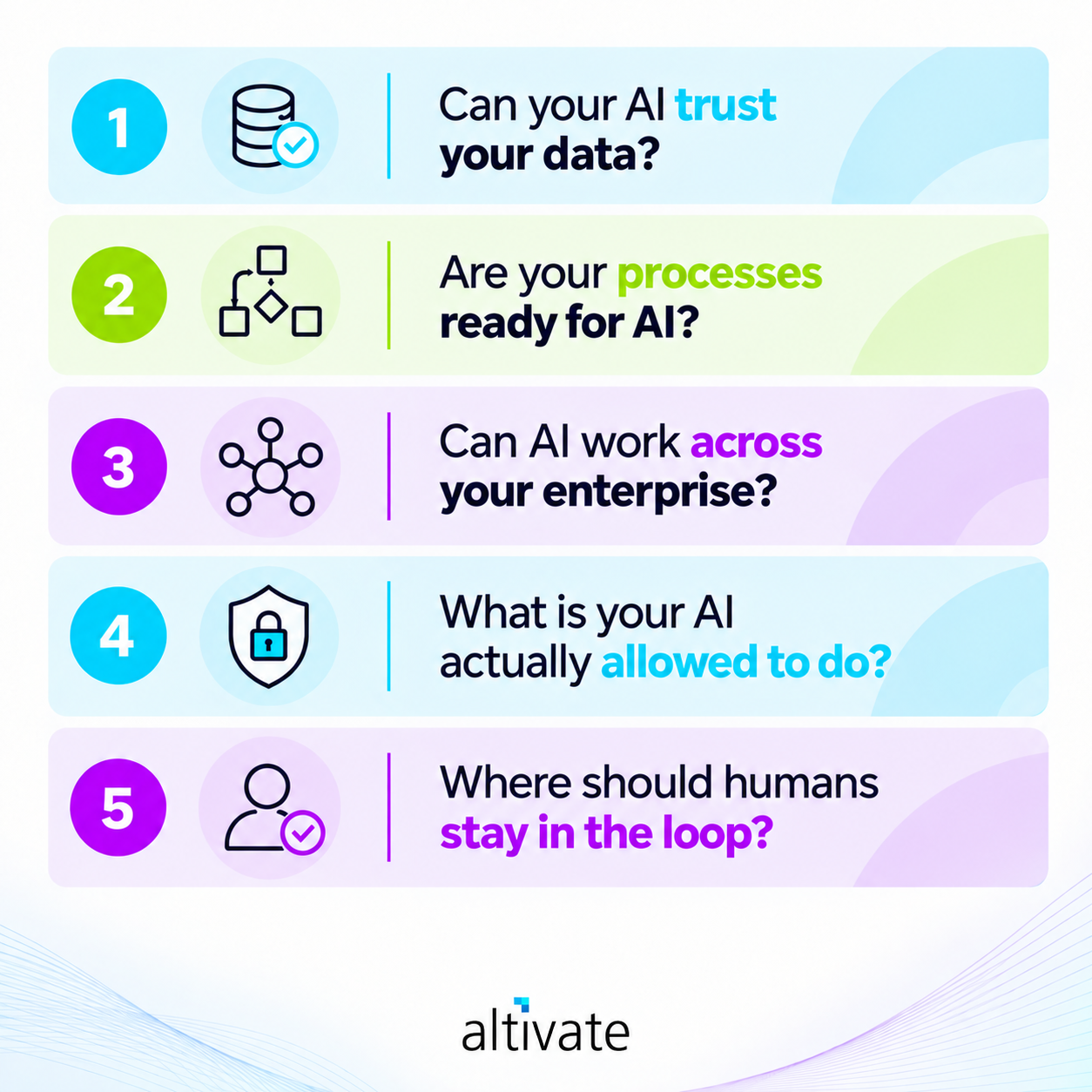
1. Can Your AI Trust Your Data?
An AI agent can only reason and act based on the context it receives. If business data is fragmented, duplicated, outdated, or inconsistent across systems, introducing more intelligent AI does not automatically fix the underlying problem.
In fact, autonomy makes data quality even more important. When AI provides an answer, a user can review it before doing anything. When AI begins triggering workflows or recommending business actions, the reliability of the underlying information becomes far more consequential.
Organizations should ask whether critical business data is consistent across systems, whether AI can access the right information in context, whether master data and business definitions are governed, and whether SAP and non-SAP information can be connected meaningfully.
SAP increasingly positions trusted business data and context as a foundation for enterprise AI. The journey toward autonomous AI may therefore begin somewhere surprisingly familiar: with better data.
2. Are Your Processes Ready for AI?
AI agents operate through processes. That means organizations also need to examine the workflows behind the technology.
Imagine asking an agent to help onboard a new supplier. If the organization has several approval processes, unclear ownership, inconsistent compliance checks, and undocumented exceptions, the agent inherits that complexity.
Automation does not automatically simplify a broken process. Sometimes it simply makes the broken process move faster.
Before introducing greater autonomy, organizations should understand the intended process, where exceptions occur, which decisions can be standardized, and where human judgment still matters.
This is why process transformation and AI transformation are increasingly connected. AI becomes more powerful when it operates inside workflows that are clearly understood, governed, and designed around measurable outcomes.
3. Can AI Work Across Your Enterprise?
Very few business processes exist inside one application. A procurement process might involve ERP, supplier platforms, inventory systems, tax requirements, approvals, document management, and external data. A finance process could involve multiple entities, applications, reporting environments, and compliance rules.
For AI agents to support these processes effectively, they need more than intelligence. They need connectivity.
The future enterprise may contain multiple specialized agents working together: one understanding procurement, another analyzing inventory, another evaluating compliance, and another supporting finance.
The value comes not simply from having more agents, but from enabling them to work across the enterprise without creating another generation of disconnected technology.
4. What Is Your AI Actually Allowed to Do?
This may become one of the most important questions in enterprise AI. If an AI system can take action, organizations must define its boundaries.
Can it recommend a purchase? Create the purchase request? Select the supplier? Submit the order? Approve the transaction? Each represents a different level of autonomy and potentially a different level of business risk.
Permissions, identity, access controls, auditability, security, and governance therefore become essential components of agentic AI.
The goal is not maximum autonomy. The goal is appropriate autonomy. People define the priorities, policies, permissions, and guardrails; AI assistants and agents operate within those boundaries.
As enterprise agents increasingly operate inside mission-critical systems, governance cannot be something added after deployment. It needs to be designed into the operating model from the beginning.
5. Where Should Humans Stay in the Loop?
The rise of autonomous systems does not mean removing people from business processes. It changes where people contribute the greatest value.
AI agents may be well suited to monitoring large volumes of information, identifying patterns, executing repetitive steps, coordinating workflows, and responding quickly to predefined situations.
Humans remain essential where organizations need judgment, accountability, empathy, negotiation, creativity, strategic direction, or decisions involving significant risk.
The more useful question may therefore not be “Can AI automate this?” but “Which parts should AI handle, and where should people remain responsible?”
A mature AI operating model will likely include different levels of autonomy. Some agents will recommend. Others may prepare actions for approval. Some may execute predefined tasks independently. And certain decisions will remain deliberately human.
The Autonomous Enterprise Is a Business Transformation
The term Autonomous Enterprise may sound like a technology concept. In practice, it represents something much broader.
It requires organizations to rethink the relationship between people, data, processes, applications, AI, and governance.
SAP’s current direction brings these areas together through SAP Autonomous Suite, SAP Business AI Platform, Joule, and AI agents grounded in enterprise business context.
But technology alone will not make an enterprise autonomous. Organizations also need trusted data, connected applications, well-designed processes, clear governance, defined accountability, and people who understand when to rely on AI – and when not to.
Your AI Can Talk. What Comes Next?
Enterprise AI has already demonstrated that it can answer questions, generate content, summarize information, and support employees. The next stage is considerably more important: AI is beginning to participate in business operations themselves.
And that means the conversation must evolve. Instead of simply asking “Where can we use AI?”, organizations should begin asking “Where are we ready for AI to act?”
That distinction will shape the next phase of enterprise transformation.
Continuing the Conversation at SAP NOW AI Tour Riyadh
On October 20, 2026, SAP NOW AI Tour Riyadh will bring together business leaders, technology experts, and partners to explore the evolving role of business AI and the Autonomous Enterprise.
For organizations attending the event, the opportunity goes beyond seeing the latest AI capabilities. It is a chance to examine what those capabilities mean for their own business: Are our processes ready? Is our data ready? Can our systems connect? Do we have the right governance? And most importantly, what are we actually ready to let AI do?
At Altivate, we help organizations connect technology with real business outcomes across SAP transformation, data, cloud, integration, and AI. As enterprise AI moves from conversation to action, that connection becomes more important than ever.
Key Takeaway
The next phase of enterprise AI is not only about better answers. It is about trusted action – and businesses need the right data, processes, connectivity, governance, and human oversight before they are ready to scale it.