AI readiness is not determined by how many tools HR has purchased. It depends on whether the organization has the data, governance, skills visibility and operating discipline required to use AI responsibly and at scale.
The next stage of HR transformation
Across Saudi Arabia, HR leaders are being asked to do more than digitize administrative work. They are expected to improve workforce planning, strengthen employee experiences, develop critical skills and support faster business decisions – while maintaining trust, privacy and compliance.
AI can help HR teams move in that direction. It can summarize information, surface workforce insights, support recruiting, personalize learning and reduce repetitive work. But introducing AI into fragmented processes or unreliable data does not create intelligent HR. It simply accelerates existing weaknesses.
This is why the conversation around SAP HR Connect KSA on September 21 in Riyadh is especially relevant. The event agenda places connected people data, skills intelligence, intelligent hiring, employee experience and Autonomous Human Capital Management at the center of the discussion.
What does AI-ready HR look like?
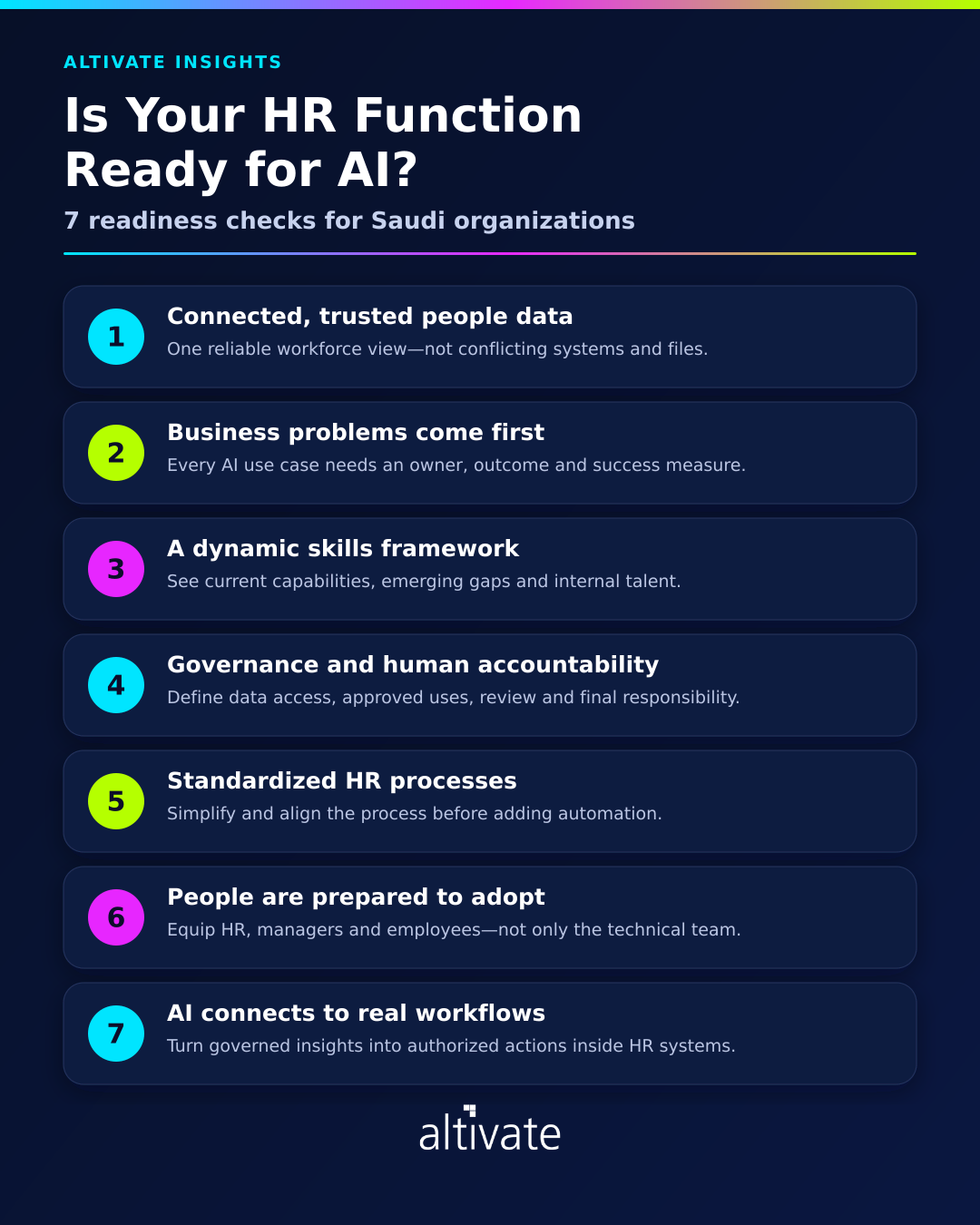
An AI-ready HR function does not need to automate everything immediately. It needs a trustworthy foundation and a clear method for deciding where AI adds genuine value. The following seven checks can help Saudi organizations assess that foundation before moving from experimentation to scaled adoption.
1. Your core people data is accurate and connected
AI outputs are only as dependable as the data and context behind them. Employee records, organizational structures, job profiles, skills, learning histories, performance information and workforce costs should not sit in disconnected systems with conflicting definitions.
Readiness check: Can HR and business leaders access one trusted view of the workforce without manually reconciling several files or platforms?
2. You have prioritized business problems – not just AI use cases
Starting with a fashionable tool often produces a short-lived pilot. Start instead with a measurable HR or business problem: long hiring cycles, limited skills visibility, repetitive employee queries, inconsistent workforce planning or low adoption of learning programs.
Readiness check: Is every proposed AI use case linked to a clear owner, business outcome and success measure?
3. Skills are defined in a usable, dynamic framework
Job titles alone cannot show whether an organization has the capabilities needed for growth. AI-supported talent decisions require a consistent skills language across recruiting, learning, performance, internal mobility and workforce planning. This is particularly important when organizations are developing national talent and planning for future capability needs.
Readiness check: Can you identify existing skills, emerging gaps and potential internal talent across the organization?
4. Governance, privacy and human accountability are built in
HR decisions affect careers, compensation, performance and access to opportunity. Organizations therefore need clear rules covering data access, approved uses, review responsibilities, bias monitoring, explainability and escalation. AI may support a decision, but accountability must remain clear.
Readiness check: Do employees and managers know when AI is being used, what data it can access and who remains responsible for the final decision?
5. HR processes are standardized before they are automated
Automating an inconsistent process can make it faster without making it better. Before adding agents, assistants or predictive capabilities, organizations should simplify approvals, clarify exceptions and align policies with the actual employee journey.
Readiness check: Are your priority HR processes documented, consistently followed and integrated with the wider business?
6. Managers and employees are prepared to adopt new ways of working
Technology adoption is not achieved at go-live. People need to understand what the new capability does, when to trust it, when to question it and how it improves their work. Role-based communication, training, feedback loops and visible leadership sponsorship are essential.
Readiness check: Is there an adoption plan for HR teams, managers and employees – not only a technical implementation plan?
7. Your platform can connect AI to real workflows
Standalone AI tools may generate useful answers, but sustained value comes when AI works with governed business data and supports end-to-end processes. A connected HCM platform makes it possible to link core HR, recruiting, learning, performance, analytics and employee experiences instead of creating another isolated layer.
Readiness check: Can AI insights trigger or support an authorized HR action inside the systems where work already happens?
How to interpret your readiness
Treat the checklist as a discussion tool rather than a pass-or-fail test:
- 6-7 checks in place: You have a strong foundation for a focused AI pilot with measurable outcomes.
- 3-5 checks in place: Prioritize the missing foundations while testing one controlled, low-risk use case.
- 0-2 checks in place: Focus first on data, process and governance readiness before scaling AI across HR.
The objective is not to delay innovation until every condition is perfect. It is to avoid scaling technology faster than the organization can govern, adopt and benefit from it.
From automation to more autonomous HCM
SAP describes Autonomous HCM as the use of AI, machine learning and automation to streamline HR processes, reduce manual effort, provide predictive insights, strengthen self-service and support more personalized careers and learning. SAP SuccessFactors HCM brings core HR, talent, skills and workforce analytics together in an AI-enabled cloud suite, while Joule assistants and agents can support role- and process-aware workflows.
For Saudi organizations, the opportunity is significant: HR can spend less time assembling information and more time strengthening workforce capability, employee experience and business performance. Reaching that point, however, requires deliberate preparation.
Is your HR function ready for its next stage of transformation?
Altivate helps organizations modernize HR with SAP SuccessFactors, connecting people, processes and data to build a stronger foundation for AI-enabled workforce decisions.