As organizations in KSA accelerate their move from SAP ECC to SAP S/4HANA, the real question is rarely “Should we migrate?” It is “Which path gets us the value we want, with the least risk?”
In our main comparison article (Brownfield vs. Greenfield vs. Bluefield in KSA), we introduced the three approaches.
You have already explored the two classic paths: Brownfield (system conversion) and Greenfield (new implementation). Now, let’s dive into the third option: Bluefield, also known as Hybrid Migration or Selective Data Transition.
What Is Bluefield Migration?
Bluefield (Selective Data Transition) is a hybrid approach that sits between Brownfield and Greenfield.
It lets you:
- Keep what works (selected history, organizational units, processes, or parts of your existing configuration)
- Redesign what must change (processes you want to standardize, simplify, or rebuild for a clean-core future)
In other words, you selectively transition to SAP S/4HANA without doing a full technical conversion of everything, and without starting from zero.
Note: “Bluefield” is commonly used in the market, but it is also a registered SNP trademark. SAP typically uses the neutral term Selective Data Transition.
Why Organizations Choose the Bluefield Approach
Bluefield is ideal when you want transformation, but you also need selective continuity. Common drivers include:
1. Selective Process Redesign
You can redesign high-impact areas (like finance, procurement, or supply chain planning) while keeping other areas stable to reduce disruption.
2. Selective History Migration
Unlike Greenfield (where history is typically not migrated by default), Bluefield enables you to migrate the right slice of historical data that matters for reporting, audits, and operational continuity.
3. System Consolidation
If your group operates multiple ECC systems across subsidiaries, Bluefield supports consolidation into a single S/4HANA target, with selective migration of relevant company codes, plants, or business units.
4. Mergers, Acquisitions, and Carve Outs
Bluefield is often a strong fit when legal entities are changing, when parts of the business are splitting, or when you need to move only specific organizational units into the new system.
5. A Practical Path to Clean Core
Bluefield supports a clean-core direction without forcing a full restart. You can reduce legacy complexity while still protecting the investments that are truly valuable.
When Bluefield Is the Right Choice
Consider Bluefield when:
- You want more transformation than Brownfield, but less disruption than Greenfield
- You need to migrate selected history, not all history
- You are consolidating multiple ECC instances into one S/4HANA target
- You are handling a merger, acquisition, carve-out, or major org redesign
- You want a phased approach by business unit, region, or company code
Bluefield is commonly positioned for S/4HANA On-Premise and S/4HANA Private Cloud, including Private Edition within RISE with SAP scenarios.
Advantages and Challenges of Bluefield Migration
Advantages
- Balanced approach: transformation plus continuity
- Selective migration of organization scope and historical data
- Supports complex group structures, consolidations, and carve-outs
- Reduces unnecessary legacy carryover versus a pure system conversion
- Enables phased execution to control risk and change impact
Challenges
- Scoping must be precise: deciding what to keep vs. redesign is a strategic decision
- Method and tooling vary by partner: SDT execution depends on the chosen approach and accelerators
- Requires strong governance across data, processes, and integrations
- Testing complexity can increase if multiple waves or mixed process models are used
Bluefield Technical Deep Dive
To add technical gravity, explicitly cover scope boundaries, cutover and downtime, tool choices, and the prerequisites that can make or break a selective data transition.
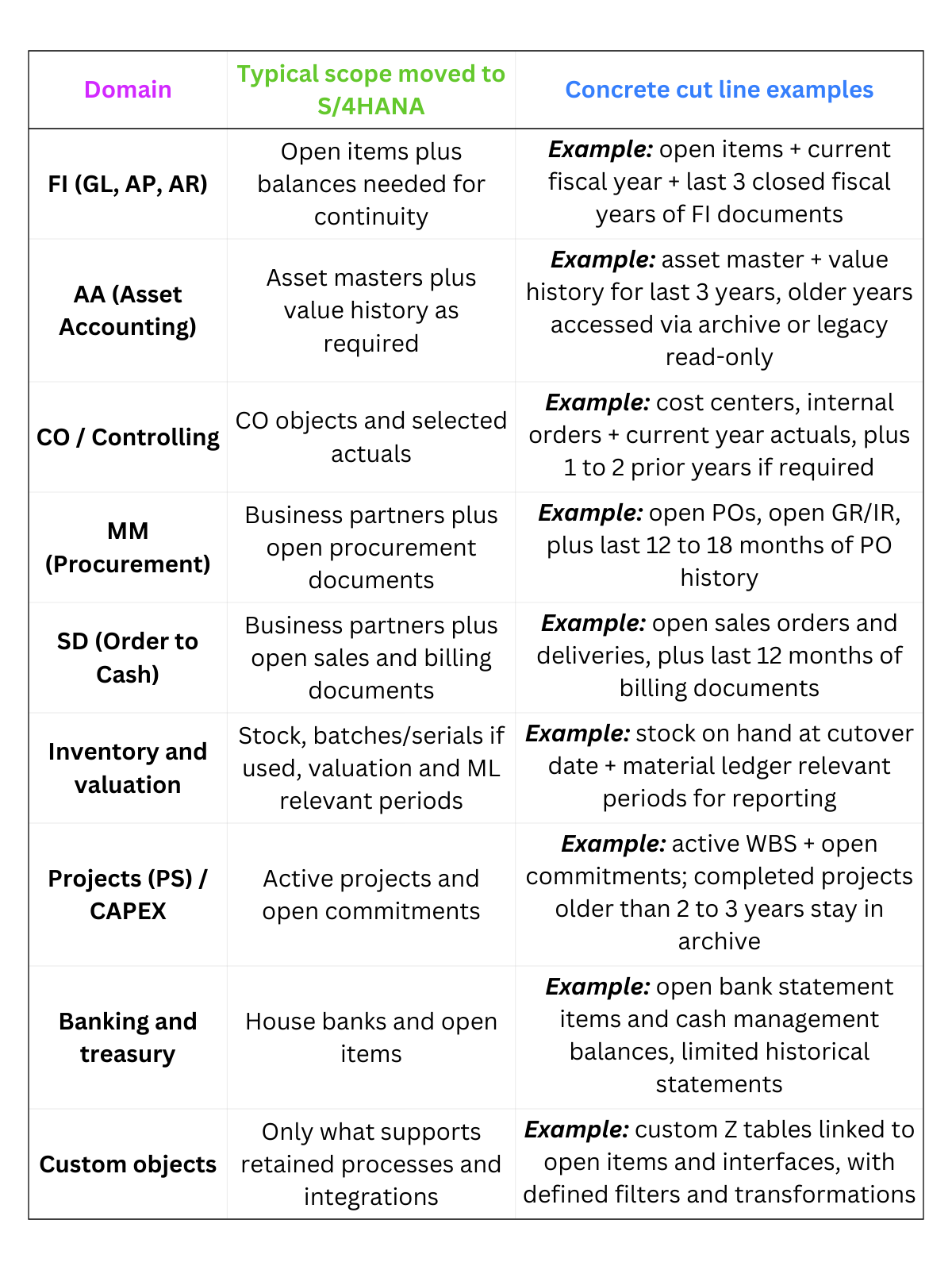
1- Scope Boundaries
In Bluefield, you typically define a cut line per data domain and agree what must be available in S/4HANA on Day 1 versus what can remain in an archive or a legacy read-only system.
2- Downtime and Cutover Implications
Downtime depends less on the label (Bluefield) and more on data volume, transformation rules, and the number of rehearsed cutovers. In most programs, you define a cutover window and then reduce it via mock runs.
Typical cutover phases: freeze changes, extract and transform data, load to S/4HANA, reconcile, validate end-to-end, then release integrations and business users.
Main drivers of downtime: transactional volume in scope, number of data objects and dependencies, custom transformations, and the amount of validation and reconciliation required.
How downtime is controlled: multiple mock cutovers, performance tuning of extract and load, delta mechanisms for selected objects, and a clear business freeze plan.
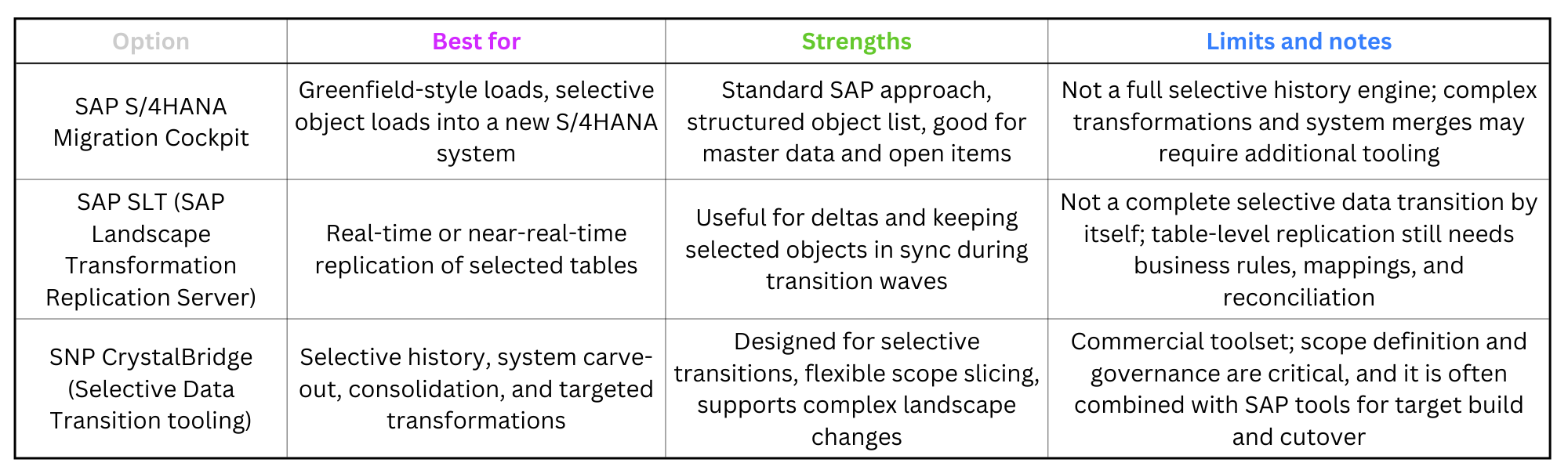
3- Tooling Options (SLT vs SNP vs SAP S/4HANA Migration Cockpit)
Tooling is often the differentiator in selective transitions. The key is to match the tool to the target outcome: initial load, selective history, system merge, carve-out, or near-real-time deltas.
4- CVI and Business Partner Conversion (Non-Negotiable in S/4HANA)
S/4HANA uses Business Partner as the single object for customer and vendor. Customer Vendor Integration (CVI) is therefore a core prerequisite, not a nice-to-have.
Map account groups to BP grouping and define number range strategy (retain numbers or re-number).
Align mandatory fields and harmonize duplicates (common blocker in groups with multiple ECC instances).
Validate contact persons, addresses, tax numbers, and bank details early to avoid load failures at cutover.
5- FI Data Consistency (Balances, Open Items, and Universal Journal Reality)
A selective transition must still produce clean financial continuity. That usually means strict rules for balances and open items, plus reconciliation between subledgers and the general ledger.
Define what moves: open items, balances, and the document history needed for audit and reporting.
Reconcile AP, AR, and AA against GL before extraction, and repeat reconciliation after load.
Plan for S/4HANA specifics: Universal Journal (ACDOCA), new Asset Accounting, parallel ledger design, and document splitting if used.
6- Archiving Realities (Where Old History Actually Lives)
When you do not migrate all history, you still need a compliant and usable access strategy for older data. This is where many projects underestimate effort.
- Option A: keep a legacy ECC system in read-only mode for a defined retention period.
- Option B: archive older data using SAP data archiving / ILM and provide access via standard archive reporting.
- Option C: extract historical data into an analytics platform (for example BW or a data lake) for reporting continuity.
What Makes a Bluefield Plan Feel Credible (Even When You Cannot Name Clients)
If you cannot cite projects publicly, you can still demonstrate credibility by listing the concrete deliverables and decision points that every serious selective transition must produce.
- Scope blueprint: which company codes, plants, and processes move in each wave, plus the data cut lines per domain.
- Object list: a detailed inventory of master data, transactional data, and custom objects in scope with transformation rules.
- Cutover plan with a realistic downtime estimate, backed by mock cutover results.
- Reconciliation and validation plan: FI reconciliations, BP/CVI checks, and end-to-end process test evidence.
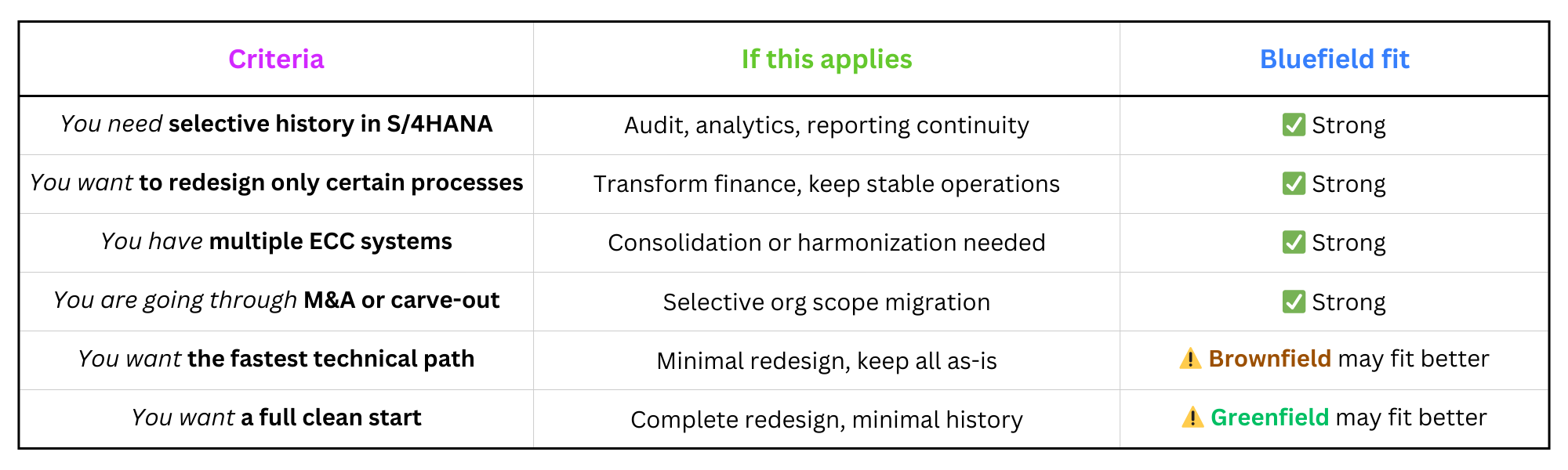
Is Bluefield a Strong Fit? Quick Criteria Check
The Bluefield Migration Roadmap (by Altivate)
A successful Bluefield program is driven by clarity: scope, data, and operating model. A typical roadmap includes:
1. Discovery and Scope Definition
Define which entities, processes, and data history will transition. Agree what will be redesigned vs retained.
2. Target Operating Model and Process Decisions
Run fit-to-standard workshops for the areas you want to transform, and document the areas that will stay aligned with existing operations.
3. Data Strategy and Selective Migration Design
Decide:
- Which master data moves
- Which transactional history moves (and how much)
- What stays archived and how it will be accessed
4. Target Architecture and Deployment Model
Confirm S/4HANA target, integration architecture, and deployment model (On-Premise or Private Cloud).
5. Build, Convert, and Selectively Transition
Prepare the S/4HANA environment, apply clean-core principles, and execute the selective transition according to the agreed scope.
6. Integration, Regression, and UAT
Validate end-to-end processes across the retained and redesigned areas, and ensure reporting continuity.
7. Cutover Planning and Execution
Execute a wave-based go-live (by entity or process) or a controlled big-bang, depending on business constraints.
8. Hypercare and Optimization
Stabilize operations, monitor performance, and activate additional S/4HANA innovations once the core is steady.
Real-World Application Example
Consider a KSA-based group with multiple subsidiaries running separate ECC systems. Leadership wants to consolidate into a single S/4HANA instance, standardize finance and procurement across the group, and still retain selected history for compliance and performance reporting.
With a Bluefield approach, the organization can:
- Transition selected company codes first
- Harmonize core finance processes
- Migrate the most relevant history into S/4HANA
- Keep certain stable operational processes intact during the early phases
The result is a controlled, business-led transformation that balances speed, continuity, and long-term simplification.
Bluefield in Summary
Bluefield (Selective Data Transition) is the hybrid path for organizations that need both transformation and continuity. It provides a practical route to modernize to SAP S/4HANA while keeping the right data, scope, and operational stability, and redesigning what truly needs to change.