Every organization has data. But not every organization can turn that data into confident decisions.
Across finance, HR, procurement, sales, operations, and executive management, businesses generate large volumes of information every day. Yet, many teams still rely on scattered reports, manual spreadsheets, disconnected dashboards, and delayed insights to guide decisions that directly affect performance, profitability, and growth.
In a fast-changing business environment, this is no longer enough.
Organizations need to understand what is happening, identify why it is happening, forecast what may happen next, and plan the best course of action with confidence. This is where SAP Analytics Cloud becomes a powerful enabler.
The Challenge: Data Exists, but Clarity Is Missing
Most businesses already have the data they need. The challenge is making that data accessible, trusted, and useful for decision-makers.
When information is spread across different systems and departments, leaders often face questions such as:
- Which numbers are accurate?
- Which report should we trust?
- Why are different teams seeing different results?
- How quickly can we understand performance?
- Can we forecast risks before they affect the business?
These challenges can slow decision-making and create uncertainty. Teams may spend more time preparing reports than analyzing results, while leaders may make decisions based on incomplete or outdated information.
What Is SAP Analytics Cloud?
SAP Analytics Cloud, also known as SAC, is SAP’s cloud solution for analytics, business intelligence, enterprise planning, and predictive insights.
It helps organizations connect data from SAP and non-SAP sources, visualize performance, build dashboards, create forecasts, run simulations, and support planning processes across departments.
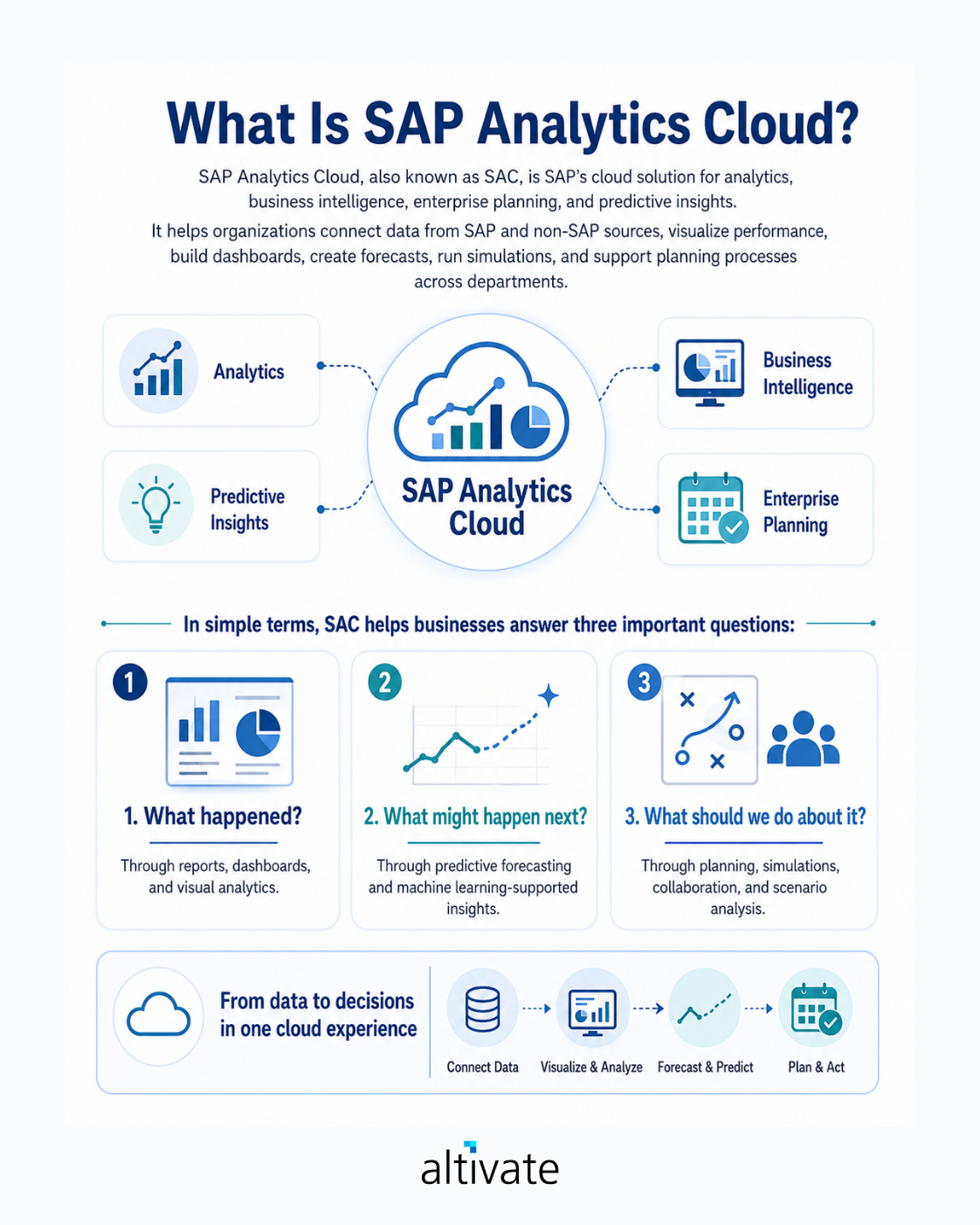
In simple terms, SAC helps businesses answer three important questions:
What happened?
Through reports, dashboards, and visual analytics.
What might happen next?
Through predictive forecasting and machine learning-supported insights.
What should we do about it?
Through planning, simulations, collaboration, and scenario analysis.
Why Traditional Reporting Is No Longer Enough
Traditional reporting is useful, but it is often backward-looking. It tells businesses what already happened.
Modern businesses need more. They need to understand trends, detect risks, simulate outcomes, forecast performance, and align teams around the next best action.
A dashboard can show that revenue declined. But decision-makers also need to understand why it declined, what may happen next, and how to respond.
SAP Analytics Cloud supports this shift by bringing together:
- Dashboards and data visualizations
- Enterprise reporting
- Predictive forecasting
- What-if analysis
- Planning and budgeting
- Collaboration and discussions
- SAP and non-SAP data connectivity
- AI-supported insights
This allows users to move from insight to action within one connected environment.
From Insight to Forecasting: Planning with More Confidence
One of the strongest values of SAP Analytics Cloud is its ability to support predictive planning and forecasting.
Businesses do not only need to know what happened last month or last quarter. They need to anticipate what could happen next.
For example:
- What will revenue look like next quarter?
- How will sales evolve across regions or product lines?
- What happens if costs increase?
- How will workforce changes affect future budgets?
- What if demand drops in a key market?
SAP Analytics Cloud helps planners and business users use historical data to generate predictive forecasts, compare forecasts with actuals, plans, and budgets, and save predictive results into planning versions.
This helps companies make decisions based on possible future outcomes, not only past results.
What-If Analysis: Preparing for Different Business Scenarios
Business conditions can change quickly. Costs may rise, demand may shift, hiring needs may evolve, and supply chain challenges may affect operations.
With SAP Analytics Cloud, organizations can simulate different scenarios and understand their potential impact.
For example, a company can ask:
- What if material costs increase?
- What if we hire more employees?
- What if sales grow in one region but decline in another?
- What if operating expenses exceed the planned budget?
With what-if analysis and simulation capabilities, decision-makers can compare different versions, evaluate risks, and prepare more informed plans before taking action.
How SAP Analytics Cloud Supports Different Business Functions
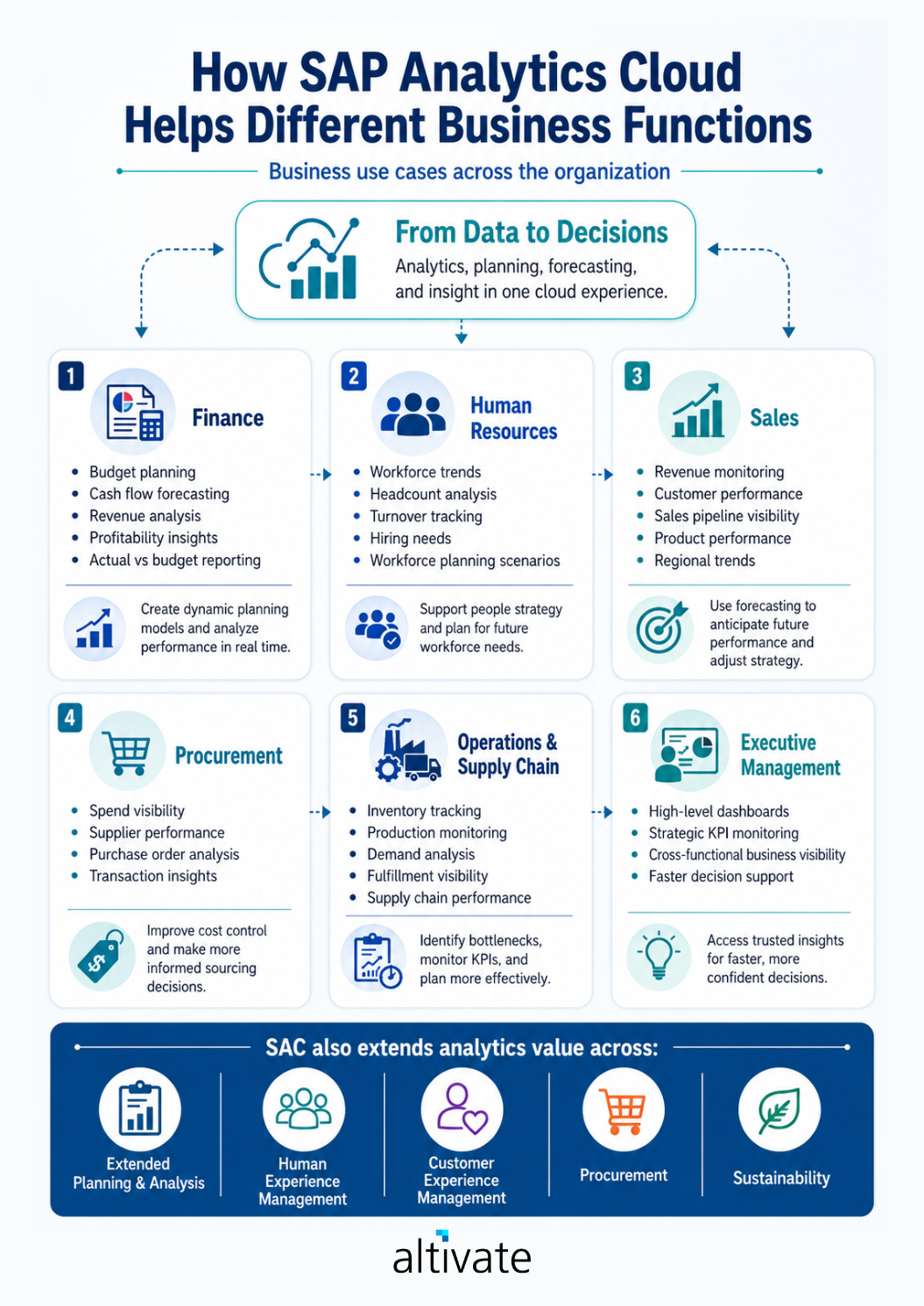
SAP Analytics Cloud can support decision-making across multiple departments by helping teams access trusted insights, monitor performance, and plan with greater confidence.
For finance teams, SAC can support budgeting, cash flow forecasting, profitability analysis, and actual vs budget reporting. For HR teams, it can provide visibility into workforce trends, headcount, turnover, and future planning needs. Sales teams can use SAC to monitor revenue, customer performance, pipeline visibility, and forecasts, while procurement teams can gain clearer insight into spend, supplier performance, and purchase order activity.
Operations and supply chain teams can also use SAC to track inventory, production, demand, fulfillment, and overall supply chain performance. At the executive level, SAC helps leadership teams access high-level dashboards, strategic KPIs, and cross-functional insights that support faster and more confident decisions.
In short, SAC helps connect data across the organization so every function can move from reporting what happened to planning what comes next.
Why SAP Analytics Cloud Is Valuable for SAP Customers
For organizations already using SAP solutions, SAP Analytics Cloud offers strong value because it connects closely with SAP’s business application landscape.
SAC can work with data from solutions such as SAP S/4HANA, SAP SuccessFactors, SAP Ariba, SAP Datasphere, SAP BW, SAP HANA, SAP Integrated Business Planning, SAP Concur, SAP Fieldglass, and other SAP sources. It can also connect to non-SAP data sources, helping organizations bring more of their business data into one analytics environment.
This is important because SAP data often comes from core business processes such as finance, procurement, supply chain, HR, sales, and operations. When analytics is connected to this data, businesses can gain insights with stronger business context.
For SAP customers, this makes SAC more than a visualization tool. It becomes a way to unlock the business value of the data already flowing through their enterprise systems.
AI-Supported Insights for Better Decision-Making
Modern analytics is also being reshaped by AI.
SAP Analytics Cloud includes AI-supported and machine learning capabilities that help users discover insights, explore data, and generate forecasts more efficiently.
These capabilities can support natural language questions, smart insights, smart discovery, predictive forecasting, and automated analysis. They can also help make analytics more accessible to business users, not only technical teams or data analysts.
Instead of waiting for someone to build a report, users can explore data, ask questions, and uncover insights more easily.
How Altivate Helps Organizations Unlock the Value of SAC
At Altivate, we help organizations turn enterprise data into actionable insights with SAP Analytics Cloud.
Our team supports businesses across the SAC journey, from identifying the right use cases to designing dashboards, building planning models, connecting SAP and non-SAP data sources, enabling predictive forecasting, and supporting user adoption.
Whether your organization wants to improve financial planning, create executive dashboards, enhance workforce analytics, monitor procurement performance, or build predictive business forecasts, Altivate can help you design and implement SAC in a way that supports your business goals.
Conclusion
Every business has data. But not every business has the visibility, forecasting, planning, and decision-making capabilities needed to use that data effectively.
SAP Analytics Cloud helps organizations move beyond static reporting and disconnected spreadsheets. It brings analytics, planning, forecasting, collaboration, and AI-supported insights into one cloud-based experience, enabling businesses to make faster, smarter, and more confident decisions.
With the right strategy and implementation partner, SAC can help organizations transform data from something they report on into something they act on.
Ready to move from data to decisions? Altivate can help you unlock the value of SAP Analytics Cloud.