As organizations accelerate their digital transformation, two names consistently appear in strategic discussions: SAP Cloud and Google Cloud. Although both sit within the cloud ecosystem, they serve very different purposes. One focuses on business operations and ERP, while the other offers a broad cloud infrastructure and innovation platform.
This article breaks down what each cloud does, where they overlap, how they work together, and how to decide which one best supports your transformation goals.
What is SAP Cloud
SAP Cloud refers primarily to SAP S/4HANA Cloud, the next generation cloud ERP designed to run core business processes on scalable, secure infrastructure. It covers finance, supply chain, procurement, HR, manufacturing, and more.
SAP S/4HANA Cloud comes in two deployment models:
1. SAP S/4HANA Cloud, Public Edition
- Multitenant SaaS environment
- Standardized best practices
- Fast deployment with lower TCO
- Automatic updates
- Limited customization
2. SAP S/4HANA Cloud, Private Edition (PCE)
- Single tenant, dedicated ERP environment
- High flexibility and customization
- Suitable for complex integrations
- Ideal for brownfield migration from ECC
- More control over upgrades and extensibility
In short: SAP Cloud is built to run core ERP and end to end business processes.
What is Google Cloud
Google Cloud Platform (GCP) is a general purpose cloud provider offering infrastructure, data analytics, AI, and application development services. It supports any kind of workload, not just ERP.
Key GCP capabilities include:
- Compute, VM, containers, Kubernetes
- Cloud storage and databases
- Data analytics and BigQuery
- AI and machine learning
- Global networking and security
- Modern app development (serverless, APIs)
- Industry solutions for manufacturing, retail, energy, finance
In short: Google Cloud is designed for innovation, data, applications, and scalable infrastructure.
SAP Cloud vs Google Cloud: What They Have in Common
Even though they serve different purposes, they share several strengths:
1. Cloud scalability
Both allow businesses to scale resources on demand.
2. Security and compliance
Each platform offers enterprise grade security, identity management, encryption, and global compliance certifications.
3. High availability and performance
Both operate on resilient cloud architectures that ensure business continuity.
4. Support for modern integration
APIs, connectors, and integration platforms allow SAP and GCP to work smoothly with other enterprise systems.
SAP Cloud vs Google Cloud: Key Differences
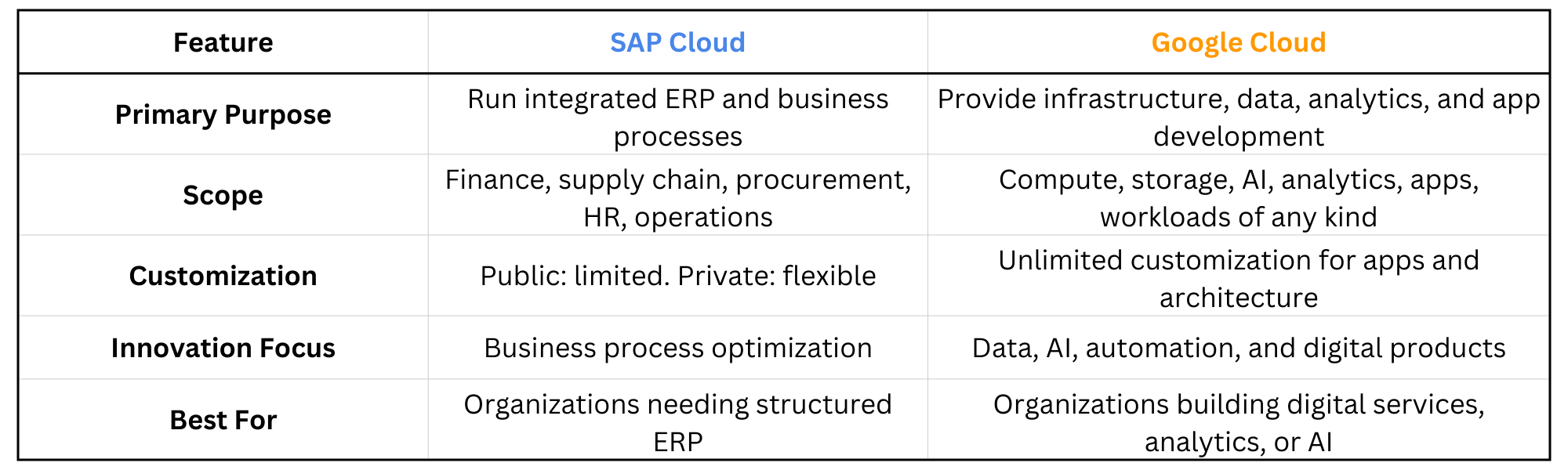
Summary: SAP Cloud is an ERP platform. Google Cloud is an innovation platform.
How SAP Cloud and Google Cloud Work Together
Many enterprises use both, especially in advanced digital transformation programs. This is where the combination becomes powerful.
1. Running SAP on Google Cloud
SAP-certified deployments allow organizations to host SAP S/4HANA Private Edition directly on GCP.
Benefits:
- High performance infrastructure
- Lower operational cost vs on premise
- More flexibility for integrations and custom extensions
- Global scale and regional data residency options
2. Extending SAP with GCP AI and Analytics
SAP ERP becomes even stronger when paired with GCP capabilities like:
- BigQuery for enterprise analytics
- Vertex AI for predictive forecasting and automation
- Data Lake modernization connected to SAP
- App modernization using microservices and APIs
3. Hybrid architectures
Companies can run core ERP on SAP Cloud while using Google Cloud for:
- AI powered business insights
- IoT and real time analytics
- Custom portals, mobile apps, and workflows
- Disaster recovery and backup
- Integration via SAP BTP and GCP services
The result is a more intelligent, scalable, insight driven enterprise.
Which One is Best for What
Choose … when:
SAP S/4HANA Cloud:
- Your primary goal is modernizing ERP
- You want standardized best practice processes
- You need full integration across finance, HR, supply chain
- You want a fast deployment and predictable TCO
- You require strong governance over business workflows
Google Cloud:
- You want to build digital applications
- Your strategy includes AI, ML, analytics, or automation
- You need scalable infrastructure for workloads beyond ERP
- You are enabling data platforms, integration layers, or innovation hubs
- You operate across multiple regions
Both:
- You want ERP excellence plus innovation
- You want SAP S/4HANA with advanced analytics
- You want to modernize without losing customization
- You want an enterprise ready hybrid architecture
- You need global scalability and AI integration for SAP processes
This is increasingly the most common scenario for digital leaders.
Final Recommendation
If you view your transformation as an ERP modernization project, SAP Cloud is the natural choice.
If you view your transformation as a data, AI, app development, or cloud innovation journey, Google Cloud gives you the flexibility and advanced capabilities you need.
But the strongest results come when SAP Cloud and Google Cloud work together. SAP provides the structure and intelligence of enterprise operations, while Google Cloud enables innovation, analytics, and scalability around it.
Together, they create a modern, connected, data driven digital foundation that supports long term growth.