As more organizations modernize their operations and move toward cloud ERP, one of the most important decisions they face is selecting the right SAP S/4HANA Cloud edition. The choice between SAP Public Cloud and SAP Private Cloud (PCE) directly affects the organization’s flexibility, cost, scalability, and digital transformation roadmap.
This guide breaks down the differences, benefits, and ideal use cases for each deployment model.
What Is SAP Cloud?
SAP Cloud refers to SAP’s complete portfolio of cloud-based solutions designed to help organizations run their core business processes on secure, scalable, and continuously updated infrastructure.
These solutions support finance, HR, supply chain, procurement, analytics, and more. Key components of the SAP Cloud portfolio include:
- RISE with SAP
- SAP S/4HANA Cloud (Public Edition)
- SAP S/4HANA Cloud, Private Edition (PCE)
- SAP SuccessFactors
- SAP Ariba
- SAP Business Technology Platform (BTP)
- And many additional cloud services
In SAP’s latest terminology, “SAP S/4HANA Cloud” refers specifically to the Public Edition. The full name for the private deployment model is “SAP S/4HANA Cloud, Private Edition”.
Both editions sit under the broader SAP Cloud umbrella.
SAP S/4HANA Cloud Public Edition
SAP S/4HANA Cloud Public Edition is SAP’s multitenant cloud ERP. It is designed for organizations seeking fast deployment, lower TCO, and standardized best practices without the need for deep customization.
Key Characteristics
- Based on SAP best practices for standardized processes
- Limited customization, with extensions created through BTP
- Automatic updates multiple times per year
- Lowest total cost of ownership
- Multitenant architecture shared with other SAP customers
Best For
- Fast-growing companies
- Organizations with simple or standardized processes
- Businesses looking for predictable operational cost
- Companies that want to minimize IT ownership and complexity
SAP S/4HANA Cloud Private Edition (PCE)
SAP S/4HANA Cloud Private Edition is a single-tenant deployment delivered through RISE with SAP. It provides higher flexibility, deeper customization, and full control over upgrade timelines.
Key Characteristics
- Dedicated system not shared with other customers
- Supports advanced customization similar to on-premise SAP
- Customer-defined upgrade schedule
- Higher total cost of ownership compared to Public Edition
- Ideal for Brownfield or hybrid migration paths
Best For
- Large enterprises with complex or specialized business processes
- Organizations upgrading from SAP ECC while preserving custom development
- Companies with strict regulatory or compliance needs
- Businesses that rely on industry-specific workflows and heavy integrations
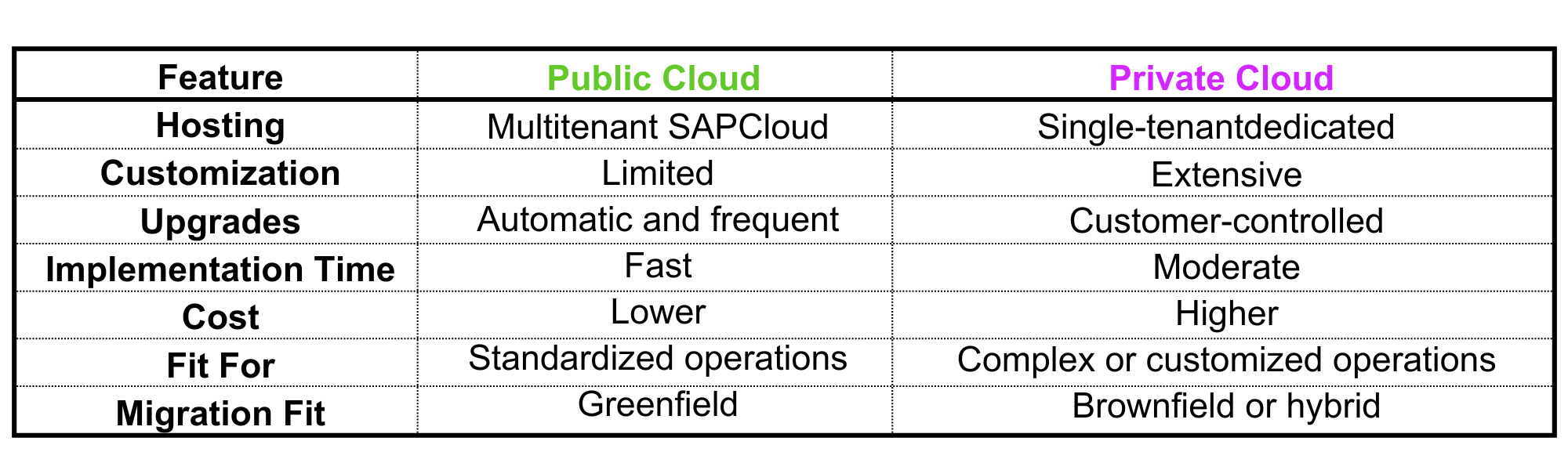
SAP Public vs Private Cloud: Quick Comparison
Here is a comparative table to explain it:
How Altivate Frames the Choice for Clients
Organizations across KSA and UAE often ask which SAP Cloud model they should adopt. At Altivate, the recommendation depends on the client’s maturity, complexity, and long-term transformation goals.
Public Cloud
Best for organizations that want to modernize quickly, adopt SAP best practices, and reduce the total cost of ownership. It is the fastest path to value with standardized capabilities.
Private Cloud (PCE)
Best for enterprises requiring flexibility, custom functionality, or a Brownfield upgrade from SAP ECC. It allows companies to modernize while preserving their unique business processes.
Both SAP Public Cloud and SAP Private Cloud offer powerful ways to transform business operations, enhance efficiency, and adopt next-generation capabilities. The right choice depends on the level of customization, operational complexity, regulatory requirements, and the pace of transformation your organization aims for.
With the right guidance, companies can confidently choose the SAP Cloud deployment model that aligns with their strategy, scale, and growth ambitions.