If you have been exploring SAP lately, you have probably come across a long list of terms that sound connected but are not always easy to understand: ECC, S/4HANA, BTP, RISE with SAP, GROW with SAP, Public Cloud, and Private Cloud.
For many business leaders, the challenge is not a lack of information. It is too much terminology, often explained in technical language. That can make it harder to understand what each term really means, how they relate to one another, and which ones matter most when planning a transformation journey.
This guide explains common SAP terminology in a simple, practical way. The goal is to help business readers understand the language behind modern SAP conversations, without turning the article into a technical manual. SAP positions SAP S/4HANA as its current ERP suite, while SAP Business Technology Platform supports integration, extension, automation, data, and AI across the enterprise.
Why SAP terminology can feel confusing
Part of the confusion comes from the fact that these terms do not all describe the same thing. Some are products, some are deployment models, and some are commercial or transformation offerings. For example, SAP S/4HANA is the ERP system itself, while Public Cloud and Private Cloud describe how it can be deployed. RISE with SAP and GROW with SAP are not the ERP product itself, but different SAP-led journeys built around different customer situations.
Once these categories are separated, the overall picture becomes much easier to understand.
1. What is SAP ECC?
SAP ECC stands for SAP ERP Central Component. In simple terms, it is SAP’s previous generation ERP system, used by organizations for many years to manage core business functions such as finance, procurement, supply chain, manufacturing, and sales. It became the foundation for many enterprise operations before the move toward newer digital core models. SAP continues to frame ECC migration as an important step for customers moving to SAP S/4HANA.
A simple way to think about ECC is this: it is the older SAP ERP environment that helped businesses standardize operations, but it belongs to an earlier generation of enterprise architecture.
2. What is SAP S/4HANA?
SAP S/4HANA is SAP’s current generation ERP system. It is designed to support more real-time visibility, a simplified data model, and a modern digital core for business operations. In practical terms, it is the platform organizations adopt when they want to modernize ERP, improve process visibility, and create a stronger foundation for innovation.
So, if ECC is the older ERP environment, S/4HANA is the newer and more future-ready ERP environment.
3. ECC vs S/4HANA: what is the difference?
The simplest distinction is this:
ECC is the legacy ERP platform many organizations have used for years.
S/4HANA is the modern ERP platform designed for a more agile, real-time, and innovation-ready environment. SAP presents S/4HANA as the path forward for organizations modernizing their ERP landscape.
From a business perspective, moving from ECC to S/4HANA is not just a software replacement. It is often part of a broader transformation effort focused on simplification, standardization, process redesign, and long-term scalability.
4. What is SAP BTP?
SAP BTP stands for SAP Business Technology Platform. SAP describes it as the platform that helps organizations integrate systems, extend applications, unify data, automate processes, and support AI-driven innovation. It brings together application development, integration, automation, analytics, and data capabilities in one environment.
In simpler terms, SAP BTP is not the ERP core itself. It is the platform around the core that helps businesses connect, extend, and innovate without overloading the ERP system with heavy customization.
A useful way to think about it is this:
SAP S/4HANA is the digital core.
SAP BTP is the platform that helps you integrate, extend, automate, and innovate around that core.
5. What is RISE with SAP?
RISE with SAP is best understood as a transformation journey for organizations modernizing their ERP landscape, especially those moving from existing SAP ERP environments toward SAP S/4HANA Cloud, Private Edition. SAP describes RISE with SAP as bringing the full ERP application stack to the cloud, not just infrastructure, and positions it around transformation, modernization, and managed cloud services.
In simple business language, RISE with SAP is designed for organizations that already have an SAP landscape and want a structured path to modernization while balancing continuity, complexity, and cloud adoption.
6. What is GROW with SAP?
GROW with SAP is positioned differently. SAP learning materials describe it as the customer journey for net-new ERP customers, with an emphasis on preconfigured solutions, transparent scope, and faster time to value.
Put simply, GROW with SAP is generally aimed at organizations looking for a more standardized cloud ERP starting point, rather than enterprises transitioning a complex long-established SAP ERP environment.
7. RISE with SAP vs GROW with SAP
Here is the simplest business-friendly way to explain the difference:
RISE with SAP is usually the better fit for organizations already running SAP and looking to modernize their ERP environment.
GROW with SAP is usually the better fit for organizations starting fresh with SAP cloud ERP in a more standardized model.
That does not mean every organization fits perfectly into one category, but this is the clearest starting point for understanding the distinction.
8. What is SAP Public Cloud?
In SAP’s current terminology, SAP S/4HANA Cloud commonly refers to the Public Edition, while the private deployment model is named SAP S/4HANA Cloud, Private Edition. Altivate’s own article explains that both are SAP S/4HANA Cloud deployment models under the broader SAP cloud umbrella.
In practical terms, Public Cloud is the more standardized cloud ERP model. It is designed for organizations that want faster deployment, lower complexity, and adoption of standard best practices rather than deep customization. Altivate also frames Public Cloud as the faster path to value for businesses that want to modernize quickly.
9. What is SAP Private Cloud?
SAP S/4HANA Cloud, Private Edition is the deployment model designed for organizations that need more flexibility, deeper customization, or a transformation path better suited to complex ERP environments. SAP highlights Private Edition within the RISE with SAP journey, while Altivate describes it as well suited for enterprises with complex requirements, industry-specific workflows, and the need for greater control over the transition path.
In simple language, Private Cloud is still cloud, but it is typically better suited to organizations that need more flexibility and a more tailored modernization journey.
10. Public Cloud vs Private Cloud: what is the main difference?
At a high level, the main difference is standardization versus flexibility.
Public Cloud is generally the better fit for organizations that want speed, simplicity, and a more standardized SaaS-style model.
Private Cloud is generally the better fit for organizations that need flexibility, deeper configuration possibilities, and a more tailored path from an existing ERP environment. That distinction is consistent with both SAP’s positioning and Altivate’s own explanation of Public Cloud versus Private Cloud.
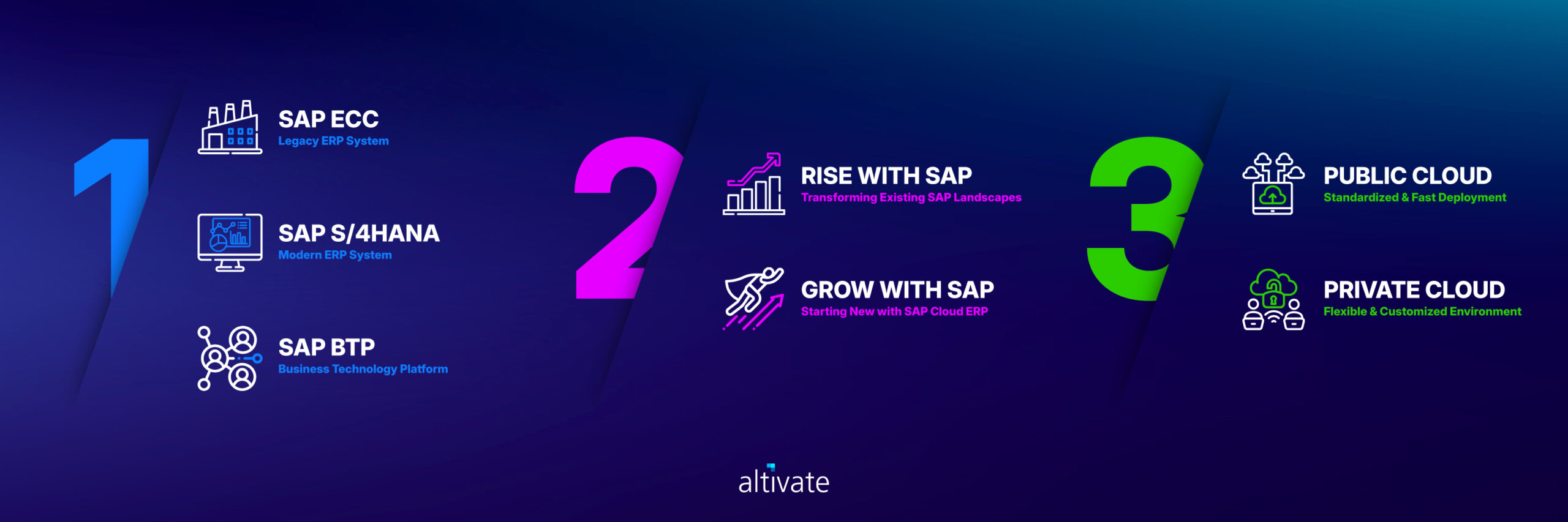
How these SAP terms connect
One reason these terms are often mixed up is because they frequently appear together in real transformation projects.
A company may start with ECC, decide to move to SAP S/4HANA, use RISE with SAP as the transformation journey, choose Private Cloud as the deployment model, and use SAP BTP to integrate systems, extend processes, and support innovation around the ERP core. Meanwhile, a newer or more greenfield-style customer may adopt GROW with SAP and a more standardized Public Cloud approach. SAP and Altivate materials reflect this broader relationship between ERP modernization, cloud deployment choice, and platform innovation.
Final takeaway
If you remember just one thing, let it be this:
- ECC is the legacy SAP ERP environment.
- S/4HANA is SAP’s current ERP generation.
- BTP is the platform that helps integrate, extend, automate, and innovate.
- RISE with SAP is generally the transformation path for existing SAP ERP customers.
- GROW with SAP is generally the path for net-new, more standardized cloud ERP adoption.
- Public Cloud emphasizes speed and standardization.
- Private Cloud emphasizes flexibility and a more tailored path.
Understanding SAP terminology does not require technical expertise. It simply requires placing each term in the right category. Once that becomes clear, SAP conversations become easier to follow, and business decisions become easier to make.
At Altivate, we help organizations simplify SAP decisions and choose the right path for transformation, whether that means moving from ECC to SAP S/4HANA, evaluating RISE with SAP or GROW with SAP, or selecting the cloud model that best supports long-term business goals.