From connected shop floors and real-time visibility to AI-assisted decisions and adaptive production scheduling
Imagine managing a large production operation while only being able to see what happened yesterday. A machine may have slowed down, a material shortage may have interrupted an order, or a quality issue may have emerged, but decision-makers would only discover it after time and resources had already been lost.
For many manufacturers, this gap between the shop floor and enterprise systems has been a long-standing challenge. Production teams work with machines, materials, labor, and quality data in real time, while business leaders depend on accurate information to manage costs, delivery commitments, and customer expectations.
SAP Digital Manufacturing helps close that gap. As a cloud-based manufacturing operations management platform, it connects production execution with enterprise processes, providing greater visibility, control, and coordination across manufacturing operations. Combined with AI capabilities, it can help manufacturers respond faster, improve quality, and move toward more adaptive and autonomous operations.
1. Connecting the Shop Floor with the Top Floor
In a traditional environment, production updates may depend on manual records, spreadsheets, or delayed system entries. When a machine stops, a component is unavailable, or an operator reports a defect, the information may take time to reach planners and management.
SAP Digital Manufacturing connects shop-floor execution with business systems and manufacturing data. Production orders, material consumption, machine information, quality results, and operational events can be captured closer to the moment they occur. This gives teams a more current and consistent view of operations across individual plants and wider manufacturing networks.
The value is not simply having more data. It is giving production supervisors, planners, quality teams, and business leaders the information they need to coordinate decisions and respond before a small disruption becomes a larger operational problem.
2. Bringing AI into Manufacturing Decisions
AI is becoming an increasingly important part of modern manufacturing. It can help identify patterns, highlight anomalies, support root-cause analysis, and make operational information easier to access.
Joule, SAP’s AI copilot, is available for interaction with SAP Digital Manufacturing. Through conversational capabilities, users can access relevant guidance and insights using natural language rather than navigating complex documentation or multiple screens. As these capabilities continue to evolve, the role of AI is shifting from simply reporting what happened to helping users understand what requires attention and what action may be appropriate.
This does not remove the need for human expertise. Instead, it can support operators and managers by reducing the time spent searching for information and helping them focus on decisions that require experience, judgment, and business context.
3. Supporting Discrete and Process Manufacturing
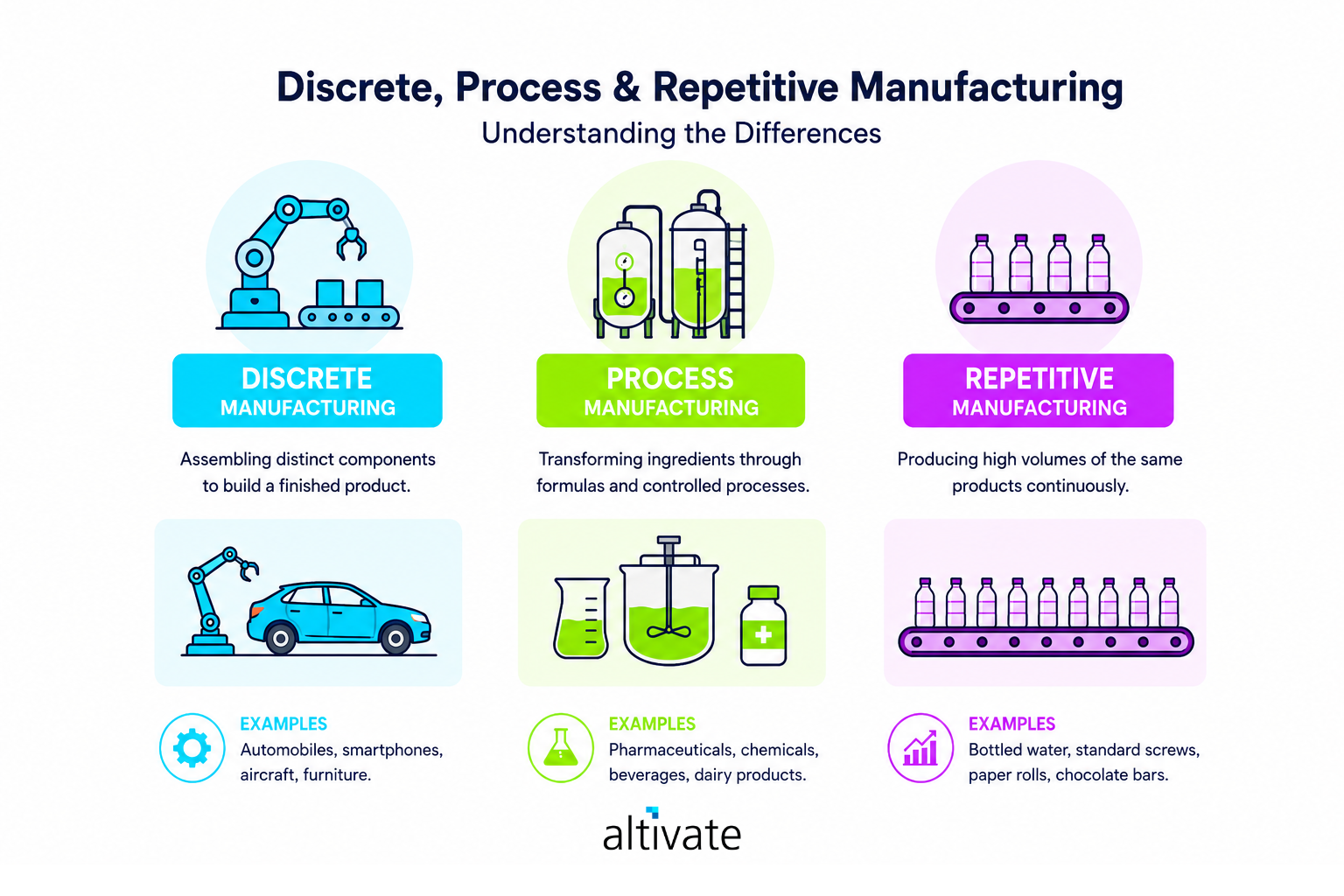
Manufacturers do not all operate in the same way. Some produce countable units, while others transform ingredients or materials through formulas and recipes:
- Discrete manufacturing focuses on individual products such as vehicles, electronics, machinery, or consumer goods.
- Process manufacturing focuses on formula- or recipe-based production such as chemicals, food and beverages, pharmaceuticals, or personal care products.
SAP Digital Manufacturing supports production processes across both discrete and process industries. This gives organizations a unified foundation for managing execution, data collection, quality, traceability, and operational visibility while still addressing the specific requirements of different manufacturing models.
4. Adapting Production with Resource Orchestration
Production scheduling becomes difficult when real-world conditions change. An urgent order may arrive, a tool may become unavailable, a worker may be reassigned, or a machine may require attention. A schedule that looked achievable in the morning can quickly become unrealistic.
Resource Orchestration in SAP Digital Manufacturing helps production supervisors bridge planning and execution. It supports the scheduling and dispatching of labor, machines, tools, and production operations while reflecting actual shop-floor conditions. Supervisors can monitor events, adjust assignments, and reschedule work when disruptions occur.
This creates a more responsive operating model. Instead of treating the production plan as static, teams can continuously align it with the resources and constraints that exist on the factory floor.
5. Using Connected Data to Anticipate Disruptions
Connected machines and industrial sensors can continuously generate information such as temperature, vibration, speed, pressure, and equipment status. When this operational data is combined with analytics and AI, manufacturers can identify abnormal patterns and gain earlier warning of potential issues.
Predictive maintenance is one example of how this information can create value. Rather than waiting for equipment to fail, maintenance teams can use condition data and predictive models to plan interventions at a more appropriate time. This can reduce unplanned downtime, protect production continuity, and improve the use of maintenance resources.
The important distinction is that SAP Digital Manufacturing provides the connected execution and data foundation, while predictive scenarios may also involve integration with asset management, IoT, analytics, and other SAP or partner capabilities. The result is a more coordinated approach to production and equipment performance.
Why SAP Digital Manufacturing Matters
For manufacturers, the business case can be summarized across four areas:
- Greater visibility: Real-time and near-real-time information helps teams understand production status, constraints, quality events, and performance across operations.
- Faster decisions: Connected data and AI-assisted insights can help users identify issues earlier and respond with better context.
- Improved quality and traceability: Detailed production records can support genealogy, compliance, investigations, and faster responses when a quality issue occurs.
- More efficient and sustainable operations: Better control of materials, labor, equipment, and production processes can help reduce waste, rework, downtime, and unnecessary resource consumption.
From Connected Manufacturing to the Autonomous Enterprise
The future of manufacturing is not defined by factories operating without people. It is defined by connected operations in which people, processes, machines, data, and AI work together more intelligently.
SAP Digital Manufacturing provides an important foundation for this shift by connecting the shop floor with enterprise processes, enabling real-time visibility, supporting flexible execution, and bringing AI closer to operational decisions. As manufacturers advance toward the Autonomous Enterprise, these capabilities can help operations become more resilient, responsive, and continuously optimized.
For organizations modernizing their manufacturing landscape, the objective is not simply to replace an old system. It is to create a connected operating model that can adapt to change, support the workforce, and turn production data into measurable business value.
How Altivate Can Help
As an SAP Gold Partner and AI Innovation Center, Altivate helps manufacturers assess their current operations, define the right SAP Digital Manufacturing roadmap, integrate shop-floor and enterprise processes, and identify practical AI use cases aligned with business priorities.
From strategy and implementation to integration, adoption, and continuous improvement, our focus is on helping manufacturers build connected, scalable operations that support their journey toward the Autonomous Enterprise and Elevating Performance.
In simpler terms, SAP Business Data Cloud helps businesses move from scattered reports and disconnected data platforms to a more unified data foundation that can support better decisions, faster insights, and AI-driven innovation.