AI assistants are becoming part of everyday business operations. They help employees retrieve information, summarize documents, analyze data, prepare reports, answer questions, and complete individual tasks faster.
As organizations expand their use of AI, however, a new challenge is emerging: most AI assistants still work separately.
An HR agent may understand employee data. A procurement agent may monitor suppliers and purchase orders. A finance agent may support budgeting and approvals. Each can provide value independently, but most business processes extend across several functions, applications, and sources of data.
The next stage of enterprise AI is therefore not only about creating more capable agents. It is about enabling specialized agents to communicate, coordinate, and work together within clearly defined boundaries.
This is the purpose behind the Agent2Agent Protocol.
What Is an AI Agent?
An AI agent is a software-based system that can understand a request, determine the steps required, interact with applications or data, and take action toward a defined objective.
Unlike a traditional chatbot, which mainly responds to questions, an AI agent can participate more actively in a workflow. Depending on its role and permissions, it may retrieve information, analyze a situation, recommend an action, trigger a process, or request approval from the appropriate person.
Organizations may use specialized agents across finance, human resources, procurement, sales, manufacturing, customer service, and other business functions. The challenge is that these agents may be built by different providers, operate on different platforms, and access different parts of the enterprise landscape. Without a common way to collaborate, they risk becoming another layer of disconnected technology.
What Is the Agent2Agent Protocol?
The Agent2Agent Protocol, commonly known as A2A, is an open standard that allows independent AI agents to discover one another’s capabilities, exchange information, delegate tasks, and coordinate work across technology platforms.
Google introduced A2A in 2025 and later contributed it to the Linux Foundation. Version 1.0 was announced in April 2026, marking an important step toward production-ready interoperability across enterprise agent ecosystems.
A2A does not require agents to expose their internal reasoning, memory, or proprietary tools. Instead, an agent declares what it can do and communicates through a standardized interface. This allows organizations and technology providers to collaborate without requiring every agent to be built on the same platform.
A2A and MCP: Complementary, Not Competing
A2A is frequently discussed alongside the Model Context Protocol, or MCP. Although both support AI interoperability, they address different needs.
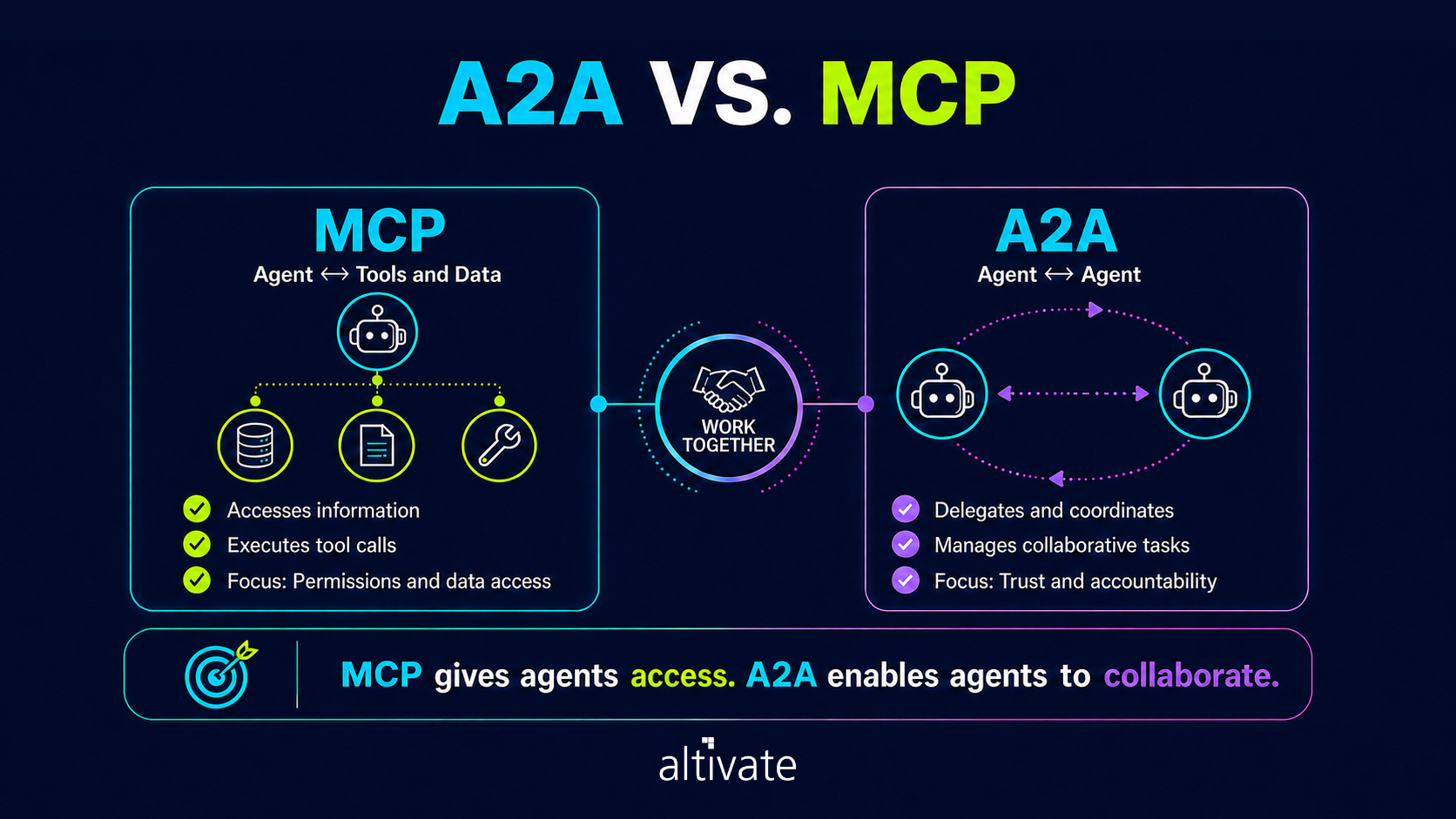
The two standards are complementary. An agent may use MCP to access the tools and information it needs, then use A2A to coordinate with another specialized agent. Most practical enterprise architectures are likely to use both.
Where SAP Joule Fits
SAP is supporting A2A as part of its enterprise AI interoperability direction. Joule can act as an A2A client, allowing it to communicate with compatible external agents, while agents can use MCP to discover and consume tools.
SAP also describes the Agent Gateway as the component intended to enable external systems to consume Joule Agents. Because availability and supported interaction patterns continue to evolve, organizations should confirm the current SAP roadmap and product availability before committing to a bidirectional architecture.
The objective is not to replace every application with a single AI system. It is to allow SAP-native agents and compatible third-party agents to contribute to the same business outcome across SAP, cloud, custom, and partner environments.
What is practical today? Start with a scenario in which Joule initiates work and an external agent responds. Treat inbound delegation to SAP-native agents as availability-dependent and verify it against current SAP guidance before implementation.
What Agent Collaboration Could Look Like
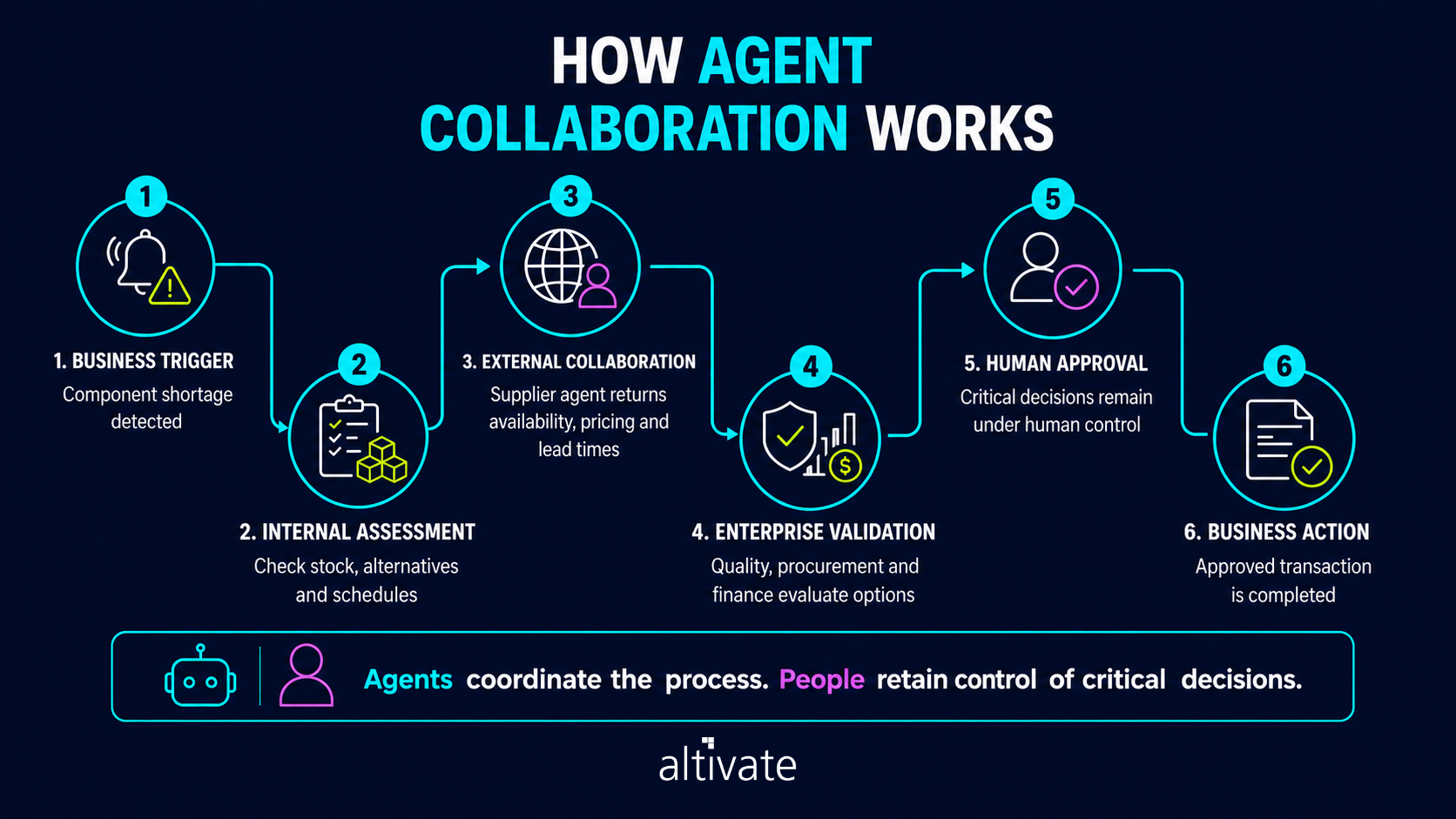
Consider a manufacturing company facing a shortage of a qualified component. A supply chain agent could first examine internal stock, approved alternatives, and rescheduling options. If external sourcing is required, it could request availability, pricing, and lead-time options from a supplier agent.
The returned options would not automatically become a purchase order. Internal quality, procurement, and finance agents could evaluate the alternatives against approved supplier lists, compliance requirements, budget thresholds, and delivery priorities. A designated employee would approve a regulated substitute or high-value commitment before any transaction is completed.
This example shows the real opportunity. Agent collaboration can reduce the manual coordination required to assemble options and begin the right process earlier. It does not remove qualification, approval, or accountability.
Similar patterns could support:
- Employee onboarding across HR, IT, security, payroll, and learning systems.
- Customer service investigations involving orders, logistics, billing, and technical support.
- Order validation across sales, credit, inventory, pricing, and finance.
- Manufacturing responses involving production, maintenance, quality, and supply chain.
Why A2A Matters for Businesses
End-to-end process coordination. AI can move beyond isolated departmental tasks and support processes involving several functions and systems.
Greater technology flexibility. A common standard can reduce the need for custom agent-to-agent integrations and limit dependence on a single provider.
Better employee experiences. Employees may initiate one request while multiple specialized agents coordinate the required work in the background.
Faster, more contextual decisions. Agents can contribute information from their respective business domains, helping create a more complete view before action is taken.
Reuse of existing investments. Organizations can connect capabilities across existing SAP, cloud, custom, and partner environments rather than replacing the full landscape.
What A2A Does Not Solve
A2A creates a common interaction model, but it is not a complete enterprise operating model. The protocol does not automatically:
- Grant an agent permission to access information or execute a transaction.
- Determine which agent is correct when two agents disagree.
- Replace identity and access management, process orchestration, or audit controls.
- Repair fragmented data, unreliable integrations, or unclear business processes.
- Transfer human accountability to technology providers or external agents.
A2A v1.0 also strengthens enterprise trust through capabilities such as signed Agent Cards, which can help verify agent identity and metadata. Even with these protocol-level features, organizations must still decide which agents are admitted, what each one may do, and how their behavior will be monitored.
Collaboration Requires an Agent Trust Model
An agent should not be allowed to access information or execute actions simply because another agent requested it. Governance must follow the full agent lifecycle, from admission and authorization to monitoring, assurance, and eventual termination.
A reliable agent ecosystem should include:
- Verified agent identities and approved counterparties.
- Role-based access, per-agent permissions, and clear delegation limits.
- Trusted, governed business data and controlled data sharing.
- Human approval for sensitive, regulated, or high-impact decisions.
- Monitoring, audit trails, incident handling, and measurable performance outcomes.
- A defined process for changing, suspending, or removing an agent from the network.
The goal is not unrestricted autonomy. It is controlled and transparent collaboration that supports employees while protecting the organization.
The Altivate Perspective: Define the Process Before Connecting the Agents
Agent-to-agent collaboration will not solve fragmented data, unclear processes, weak governance, or disconnected systems by itself. If the underlying information is incomplete or unreliable, agents may coordinate faster while still producing the wrong outcome. If decision rights are unclear, automation can increase risk instead of reducing it.
The organizations best prepared for agent collaboration will not necessarily be those with the largest number of AI agents. They will be those that can clearly define what each process does, which decisions can be delegated, what information may be shared, what the agent must return, and when human intervention is required.
Before building an agent network, organizations should ask:
- Are the relevant business processes clearly understood?
- Is the required enterprise data connected, trusted, and governed?
- Are system integrations reliable?
- Can each agent’s capabilities, permissions, inputs, and outputs be defined?
- Which decisions must remain under human control?
- How will agent activity and business outcomes be monitored?
- Which use case offers measurable value with an acceptable level of risk?
A Practical Starting Point
- Identify one process that involves repeated coordination across systems or teams.
- Select a low-risk scenario in which agents recommend or retrieve information before they transact.
- Define the participating agents, data boundaries, permissions, refusal conditions, and human approval points.
- Measure the current process before automating it, including coordination time, intervention rate, error rate, and outcome quality.
- Pilot with a limited number of agents, then expand only when the controls and business value are proven.
This approach keeps the first implementation focused on a measurable business problem rather than on deploying agents simply because the technology is available.
From Individual Assistants to Connected Enterprise Intelligence
The future of enterprise AI is unlikely to depend on one assistant that performs every task. It will be shaped by networks of specialized agents, each contributing its capabilities, business context, and authorized system access toward a shared outcome.
The Agent2Agent Protocol provides an important foundation for this future. It can help organizations move from isolated task automation toward more connected processes, faster decisions, and less manual coordination.
But interoperability is only the beginning. Sustainable value will depend on trusted data, reliable integrations, clearly defined processes, responsible governance, and a precise understanding of where people must remain in control.
The next stage of enterprise AI is not simply about making individual agents more intelligent. It is about helping intelligence work together responsibly.
How Altivate Can Help
Altivate helps organizations assess enterprise AI readiness, identify high-value agent collaboration scenarios, strengthen SAP, data, and integration foundations, and design governed AI architectures across enterprise and cloud environments.
By combining SAP expertise, enterprise AI, cloud platforms, business process understanding, and responsible governance, we help organizations move from experimentation toward practical, connected, and measurable outcomes.
Ready to explore the right starting point? Contact Altivate to identify where collaborative AI agents could deliver meaningful value across your enterprise landscape.