A chemical product may be ready to manufacture, ship, or enter a new market. Yet behind that commercial decision is a complex chain of regulatory classification, substance information, safety data sheets (SDS), labels, approvals and market-specific obligations. When that chain depends heavily on manual review, the cost is bigger than the hours spent preparing documents. It can affect how quickly teams answer customer requests, how consistently they manage changes, and how confidently they demonstrate compliance.
The next opportunity is not to replace chemical safety expertise with AI. It is to use better-connected data and carefully governed automation to remove repetitive steps, flag missing information and help qualified specialists focus on decisions that actually require their judgment.
Why compliance work becomes an operational bottleneck
Product compliance is rarely one isolated activity. A formulation change may require updated classification, different label text, a revised SDS and a check of whether the product remains marketable in each destination. A new supplier can change the available substance evidence. A sales order can introduce new destination requirements. And dangerous-goods information must remain aligned with logistics execution.
Where spreadsheets, document folders and disconnected processes dominate, teams can spend valuable time locating the latest version, reconciling fields, chasing approvals and repeating checks already performed elsewhere. The result is not merely an administrative burden: incomplete or stale information can create delays, rework and avoidable compliance risk.
What the SAP foundation already doesEM
SAP S/4HANA for product compliance supports the management of chemical compliance, product marketability, dangerous-goods classification, safety data sheets and labels. Its processes can connect compliance information with procurement, manufacturing, sales and logistics, depending on the deployed edition and scope. SAP Environment, Health, and Safety addresses a related but distinct area: the management of workplace and environmental safety processes.
That distinction matters. Product compliance concerns whether and how a product can be supplied and communicated safely in a market; operational EHS deals with risks inside the organization and at its sites. A well-designed approach connects the relevant information while keeping roles, controls and responsibilities explicit.
What changed in 2026: AI for GHS classification
In May 2026, SAP announced a new group of sustainability AI agents, including a Product Compliance Assessment Agent for Global Harmonized System (GHS) classification work. The concept is to assist with multi-step tasks such as structuring available information, applying relevant classification logic and preparing traceable outputs for specialist review. SAP described potential reductions of up to 80% in manual GHS classification effort. That is a vendor-reported potential, not a guaranteed customer outcome.
At the time of the announcement, SAP said the new sustainability agents were expected to become generally available by the end of 2026. Organizations evaluating the capability in October 2026 should verify its actual release status, country coverage, prerequisites and licensing before making an implementation commitment.
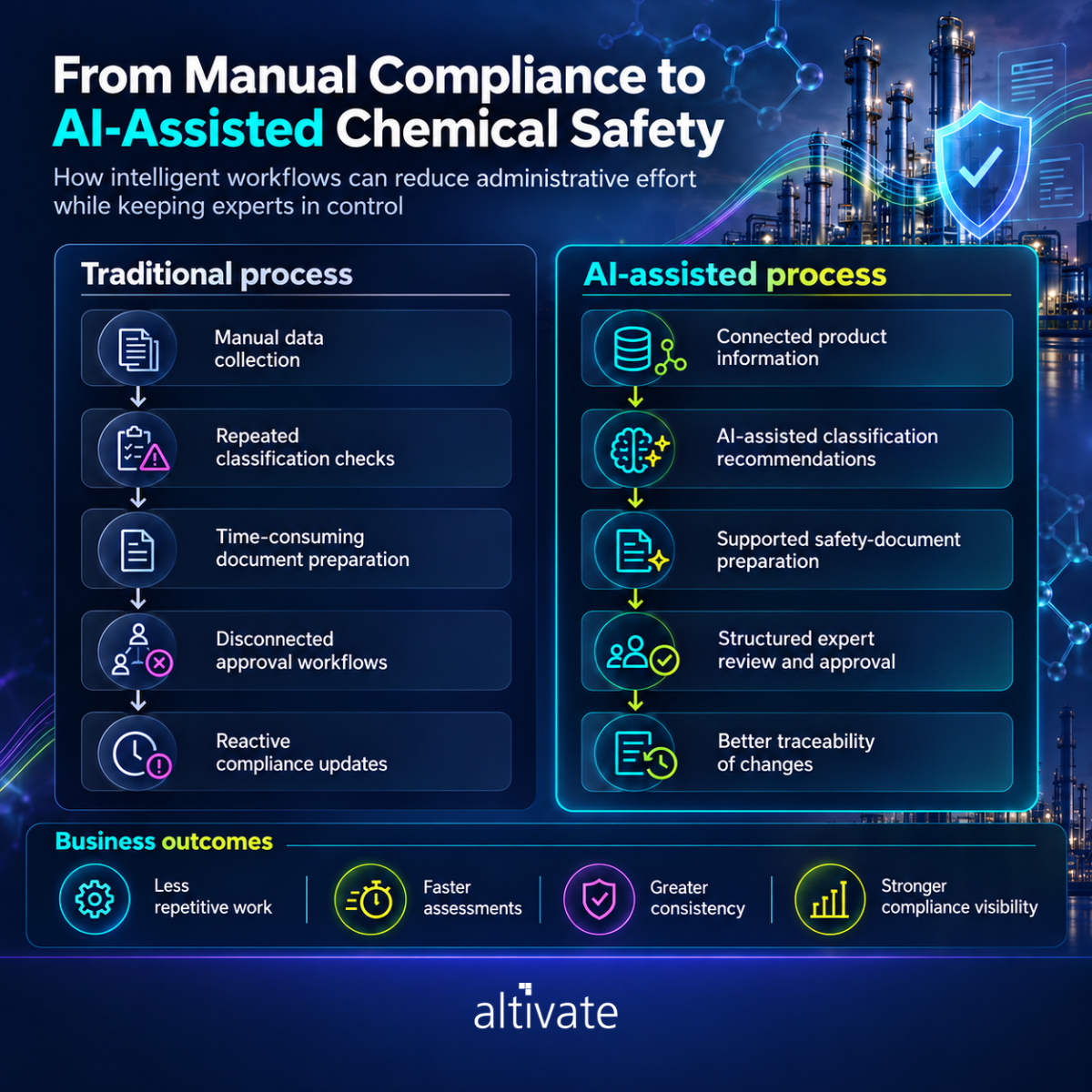
The meaningful change is not simply faster document production. It is the possibility of creating a better workflow between trusted chemical data, regulatory rules, AI-assisted preparation and accountable human approval.
A practical workflow: from formulation change to approved output
- Detect the trigger. A changed formulation, supplier record or destination market initiates a compliance review.
- Gather the evidence. Authorized teams retrieve the relevant composition, substance attributes and regulatory data from controlled sources.
- Prepare a proposed assessment. Automation or an AI-assisted agent identifies data gaps and drafts classification-related work where supported.
- Review exceptions. Qualified product-safety specialists verify the reasoning, source evidence and market requirements, and resolve disagreements.
- Approve and distribute. Only approved classification and documentation feed downstream product, sales, shipping and communication processes.
- Preserve traceability. The organization records versions, accountable reviewers, source changes and the rationale for decisions.
This is an illustrative target workflow, not a claim that one SAP agent automates all six steps out of the box. The precise process and integrations depend on the customer’s environment.
Where business value should actually be measured
The business case should begin with baseline metrics, not with a promised AI percentage. Track the time to complete a GHS assessment, percentage of assessments returned for missing data, time to update an SDS after a formulation change, share of submissions approved on first review, and number of compliance-related shipment holds. These measures connect work reduction with the quality and reliability of the end-to-end process.
A pilot can begin with one well-defined product family and a limited set of jurisdictions. That makes it easier to evaluate data quality, exception handling, regulatory interpretation and the true amount of specialist intervention before expanding to more complex product lines.
Where do AWS and Google Cloud fit?
For this particular problem, SAP Product Compliance is the logical starting point. Neither AWS nor Google Cloud needs to be added simply to make the architecture sound more innovative. Additional cloud services may be useful if a company has an established data platform, needs to analyze large historical document collections, or wants to combine operational and external information for broader insights. Any such integration needs separate validation of data protection, approved architecture, source traceability and regulatory controls.
The strongest story is therefore SAP-led: first improve the compliance data and workflow, then add adjacent analytics only when they solve a clear business problem.
What chemicals leaders should ask before investing
- Which classifications, SDS updates or marketability reviews consume the most specialist time today?
- Is chemical composition and regulatory evidence complete, current and governed?
- Which tasks can be prepared automatically, and which require mandatory human sign-off?
- Can the business trace every material decision back to the source data and accountable reviewer?
- What measurable outcome would justify a pilot: fewer review hours, faster turnaround, less rework or fewer shipment holds?
From paperwork to a more reliable operating process
Chemical compliance will never be a “set it and forget it” activity. Regulations evolve, formulations change and regional requirements differ. But it does not have to remain a patchwork of disconnected handoffs and repetitive checks.
By strengthening the SAP compliance foundation and selectively introducing AI-assisted workflows, chemical companies can give specialists better information, reduce avoidable effort and create a clearer audit trail. The objective is not autonomous sign-off. It is more timely, consistent and defensible decisions—with qualified experts firmly in control.
Altivate works with chemicals businesses on SAP-enabled operational transformation, including SAP S/4HANA, Product Safety and EHS. If your team is assessing the manual burden of classification, SDS management or product marketability checks, contact us to explore where a practical, governed improvement could begin.