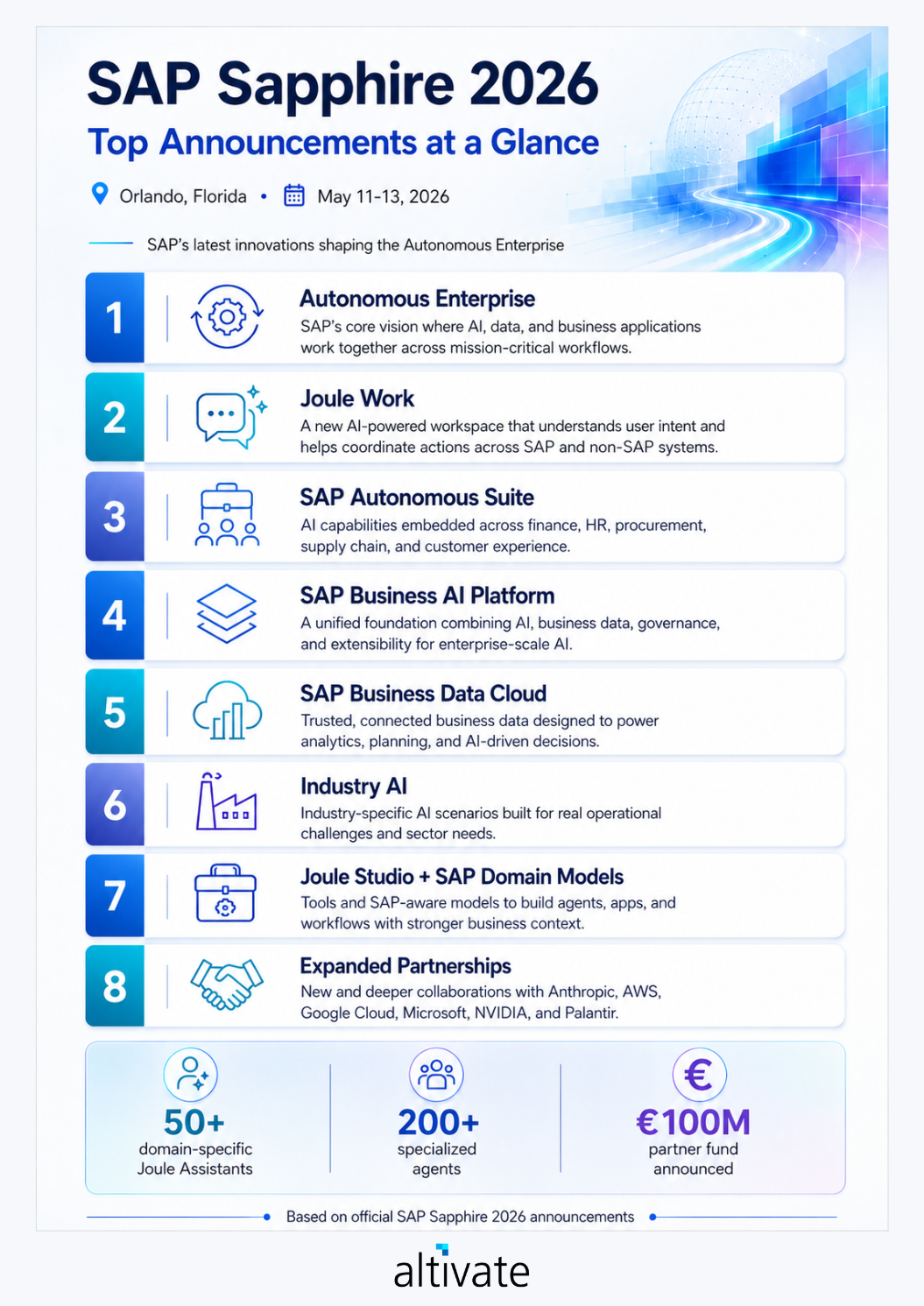
SAP Sapphire 2026 brought together SAP leaders, customers, partners, and technology innovators to explore the future of enterprise transformation.
The main SAP Sapphire & ASUG Annual Conference was held in Orlando, Florida, from May 11 to 13, 2026, at the Orange County Convention Center. SAP also hosted SAP Sapphire Madrid at IFEMA Madrid from May 19 to 21, 2026, with SAP Sapphire Virtual taking place on May 12 and 13, 2026.
This year’s theme focused strongly on the Autonomous Enterprise, SAP’s vision for a future where AI assistants, agents, business data, and enterprise applications work together to help organizations operate with greater intelligence, speed, and control.
SAP’s global keynote featured SAP CEO Christian Klein, Member of the Executive Board Muhammad Alam, CTO Philipp Herzig, and COO Sebastian Steinhaeuser. SAP also featured a celebrity keynote by tennis champion and philanthropist Roger Federer, focused on resilience, performance, and leadership.
At the center of the announcements was a clear message: enterprise AI is moving beyond experimentation. SAP is positioning AI as a practical, embedded part of business operations, supported by trusted data, process context, governance, and cloud-based innovation.
For Altivate, these announcements are not only technology updates. They reflect the direction many organizations are already moving toward: smarter ERP landscapes, cleaner business data, stronger cloud foundations, and AI-supported decision-making. As an SAP partner with experience across SAP S/4HANA, SAP Business Technology Platform, cloud, analytics, and enterprise transformation, Altivate helps businesses understand what these innovations mean in practice and how to turn them into a realistic transformation roadmap.
Main Announcements from SAP Sapphire 2026
1. The Autonomous Enterprise
SAP introduced a stronger vision for the Autonomous Enterprise, where humans, AI assistants, and AI agents work together across business workflows.
This vision is built around three key pillars: Joule Work, SAP Autonomous Suite, and the SAP Business AI Platform. Together, they are designed to help organizations automate routine work, improve decision-making, and support business processes across public and private cloud ERP environments.
For businesses, this vision highlights the importance of having the right digital foundation in place. An autonomous enterprise cannot be built on disconnected systems, fragmented processes, or ungoverned data. It requires modern ERP, integrated workflows, trusted data, cloud readiness, and strong adoption across business teams.
This is where Altivate helps organizations assess their current landscape, identify readiness gaps, and build a transformation roadmap that connects technology innovation with practical business outcomes.
2. Joule Work
One of the biggest announcements was Joule Work, SAP’s reimagined AI-powered workspace.
Joule Work is designed to help users interact with SAP and non-SAP systems through natural language. Instead of navigating multiple applications manually, users can express what they want to accomplish, and Joule can help coordinate assistants, agents, insights, and actions across business processes.
This marks an important shift in how users may work with enterprise systems, moving from fragmented interfaces toward a more unified and intent-driven experience.
For organizations, this also changes how they need to think about user adoption. AI-powered workspaces can only create value when business users trust them, understand them, and use them in daily operations. Altivate supports organizations not only with implementation, but also with process alignment, change management, and user enablement, helping teams adopt new ways of working with confidence.
3. SAP Autonomous Suite
SAP also announced the SAP Autonomous Suite, which brings AI-powered capabilities into key business functions such as finance, spend management, HR, supply chain, customer experience, and more.
The goal is to embed AI directly into the processes that drive enterprise performance, helping organizations reduce manual tasks, improve visibility, and support faster decisions.
For businesses, this means AI should not be treated as a separate initiative. It needs to be connected to real operational challenges, measurable business outcomes, and the processes that matter most.
Altivate helps organizations identify where automation and AI can create the most impact, whether in finance operations, procurement, HR, supply chain, analytics, or industry-specific workflows. This allows businesses to move beyond experimentation and focus on use cases that support performance, efficiency, and scalability.
4. SAP Business AI Platform
SAP highlighted the SAP Business AI Platform as the foundation for building, managing, and governing enterprise AI.
This platform connects AI agents, SAP business data, process knowledge, governance, and enterprise applications. This is especially important because business AI needs more than a model. It needs trusted data, clear business context, and secure execution.
Enterprise AI also requires a strong strategy. Organizations need to understand which processes are ready for AI, where their data quality stands, how governance should be applied, and how AI outputs will be monitored and used.
Altivate helps businesses approach AI adoption with structure. From identifying practical use cases to preparing the right data, platform, and governance foundation, Altivate supports organizations in building AI readiness that is aligned with business priorities.
5. SAP Business Data Cloud
Another major focus was SAP Business Data Cloud, which SAP positioned as a key foundation for enterprise AI.
The message is simple: AI becomes more valuable when it is powered by trusted, connected, and well-governed business data. SAP Business Data Cloud is designed to help organizations bring together SAP and non-SAP data, making it easier to support analytics, planning, and AI-driven decision-making.
For organizations, this means data readiness is becoming a critical part of AI readiness. Businesses cannot fully benefit from AI if their data remains fragmented, inconsistent, or difficult to access.
Altivate helps organizations assess their current data landscape, connect SAP and non-SAP systems, improve reporting and analytics capabilities, and build the foundation needed for trusted insights, planning, and AI-supported decisions.
6. Industry AI
SAP also emphasized Industry AI, with AI scenarios designed around specific industries and business needs.
Instead of focusing only on generic AI use cases, SAP is moving toward AI that understands industry-specific challenges across areas such as manufacturing, finance, supply chain, procurement, HR, customer experience, and asset-intensive industries.
This is especially important because each industry has different priorities, risks, processes, and performance indicators. A manufacturing company, for example, may focus on production efficiency, inventory visibility, and quality control, while a professional services organization may prioritize project profitability, resource planning, and financial performance.
Altivate works with organizations across several industries to align SAP capabilities with sector-specific needs. By combining SAP expertise, cloud knowledge, analytics, and business process understanding, Altivate helps companies identify the most relevant transformation priorities for their industry and growth stage.
7. Joule Studio
SAP announced Joule Studio, a new environment designed to help organizations build and extend AI agents, applications, and workflows.
This gives businesses more flexibility to adapt SAP AI capabilities to their own processes, requirements, and enterprise landscapes.
For organizations, this is an important step toward more tailored innovation. However, building or extending AI agents requires more than technical access. It requires a clear understanding of business processes, system architecture, data flows, security, and governance.
Altivate helps businesses evaluate where custom extensions, workflows, and AI-powered capabilities can support their operations, while ensuring that innovation remains aligned with enterprise standards, integration needs, and long-term scalability.
8. SAP Domain Models
SAP introduced SAP Domain Models, which are AI models designed around SAP-specific business knowledge, processes, architecture, code, metadata, and documentation.
This matters because enterprise AI needs to understand business language and SAP context. These models are intended to make AI outputs more relevant, accurate, and useful for SAP customers.
For businesses, this reinforces the importance of process context. AI becomes more valuable when it understands how the organization actually works, how decisions are made, and how business processes connect across functions.
Altivate helps organizations strengthen this foundation through process optimization, SAP implementation expertise, integration, and data alignment, making it easier for businesses to benefit from AI capabilities that are connected to real enterprise operations.
9. AI Agent Hub
SAP also announced enhancements around AI Agent Hub, designed to help organizations discover, govern, monitor, and manage AI agents across the enterprise.
As AI agents become more involved in business operations, governance becomes essential. Organizations need visibility, control, and trust to make sure AI is used responsibly and securely.
For businesses, this means AI adoption must include governance from the beginning. It is not enough to deploy AI agents. Organizations need to define ownership, monitor performance, manage risks, and ensure that AI is used in a secure and responsible way.
Altivate helps businesses think beyond implementation by supporting the governance, integration, and operational readiness needed to adopt AI in a controlled and sustainable manner.
10. Expanded Technology Partnerships
SAP also announced and deepened strategic partnerships with major technology leaders, including Anthropic, AWS, Google Cloud, Microsoft, NVIDIA, and Palantir, supporting SAP’s broader vision for the Autonomous Enterprise.
One of the key partnership highlights was SAP’s collaboration with Anthropic, the company behind Claude. SAP announced plans to bring Claude’s agentic AI capabilities into the SAP Business AI Platform, strengthening Joule and supporting more advanced AI use cases across SAP business workflows.
SAP and AWS also announced plans for SAP Business Data Cloud Connect for Amazon Athena, designed to enable bi-directional zero-copy integration between Amazon Athena and SAP Business Data Cloud. This supports SAP’s direction toward more open, connected, and scalable enterprise data environments.
For customers, these partnerships create more possibilities, but also more complexity. Businesses need to understand how SAP, hyperscalers, AI platforms, and data tools can work together within their own enterprise landscape.
Altivate’s experience across SAP, AWS, Microsoft Azure, Google Cloud, analytics, and integration helps organizations design connected architectures that support both current needs and future innovation.
What These Announcements Mean for Businesses
SAP Sapphire 2026 made one thing clear: AI is becoming a core part of enterprise transformation.
For businesses, the focus is no longer only on exploring AI. The next step is preparing the right foundation for AI to create real value. That includes modern ERP systems, clean and connected data, strong governance, cloud readiness, integrated processes, and a clear roadmap tied to business outcomes.
With announcements around Joule Work, SAP Autonomous Suite, SAP Business AI Platform, SAP Business Data Cloud, Industry AI, Joule Studio, AI Agent Hub, and new technology partnerships, SAP is showing how AI can become more deeply embedded into the way organizations plan, decide, and perform.
However, turning this vision into reality requires more than technology adoption. It requires a clear understanding of where the business is today, which systems and processes need to evolve, and how innovation can be connected to measurable performance.
How Altivate Helps Organizations Move Toward the Autonomous Enterprise
SAP Sapphire 2026 highlighted an important shift: the future of enterprise transformation will not be built on isolated systems, disconnected data, or standalone AI tools. It will depend on connected processes, trusted business data, cloud-ready platforms, and AI capabilities that are embedded into daily operations.
This is where Altivate helps organizations move from vision to execution.
Altivate supports businesses across the key foundations needed for the Autonomous Enterprise, including:
ERP Modernization
Altivate helps organizations move to modern SAP S/4HANA environments, whether through new implementations, system conversions, cloud transformation, or industry-focused ERP roadmaps.
A strong ERP foundation is essential for any organization looking to benefit from automation, AI, analytics, and connected enterprise processes.
Cloud and Platform Readiness
Altivate supports businesses in building scalable, secure, and future-ready cloud environments across SAP, AWS, Microsoft Azure, and Google Cloud.
As enterprises move toward more intelligent and connected operations, cloud readiness becomes a critical enabler of speed, flexibility, and innovation.
Data and Analytics Foundation
Altivate helps organizations connect, structure, and govern business data so it can support reporting, planning, predictive insights, and AI-powered decision-making.
This foundation is especially important as businesses prepare to use solutions such as SAP Business Data Cloud and SAP Business AI.
SAP Business AI Adoption
Altivate helps organizations identify practical AI use cases, align them with business priorities, and prepare the processes, data, and governance needed to use AI responsibly.
The goal is not to adopt AI for the sake of innovation, but to focus on areas where AI can support better decisions, stronger performance, and more efficient operations.
Integration and Process Optimization
Altivate supports businesses in connecting SAP and non-SAP systems, improving workflows, and helping teams move toward more automated and intelligent business operations.
This is especially important for organizations with complex landscapes, multiple platforms, or evolving business requirements.
Change Management and User Enablement
Technology creates value only when people use it effectively. Altivate supports organizations with change management, user adoption, training, and enablement to help teams embrace new systems, processes, and ways of working.
Through this approach, Altivate helps organizations understand where they are today, define where they want to go, and build a practical path toward becoming more intelligent, connected, and future-ready.
Conclusion
SAP Sapphire 2026 made one thing clear: enterprise AI is no longer a future concept. It is becoming part of how businesses will plan, operate, decide, and grow.
But technology announcements alone do not create transformation. Organizations need the right ERP foundation, connected data, cloud readiness, governance, integration, and adoption strategy to turn innovation into business value.
At Altivate, this is where we see the opportunity. As businesses look toward the Autonomous Enterprise, Altivate helps them connect SAP innovation with their own operational realities, industry needs, and long-term growth goals. From SAP S/4HANA and cloud transformation to data, analytics, AI readiness, and enterprise integration, we support organizations in building the foundation for smarter, more resilient, and future-ready performance.
This is how SAP’s vision becomes more than an announcement. It becomes a practical transformation journey.