Production has finished. Packaging may be complete. But the finished batch is still waiting. Quality teams are checking laboratory results, reconciling manufacturing records, reviewing deviations and confirming that every required approval is in place.
In pharmaceutical manufacturing, the time between the end of production and release can be as consequential as production efficiency itself. A delay may be necessary to protect quality and patients. Yet other delays result from fragmented evidence, manual reconciliation and unclear handoffs. The challenge is knowing which is which.
The release bottleneck is not always on the production line
A batch-release decision draws on information that rarely originates in one place: production and packaging records, inspection results, laboratory tests, material traceability, deviations, corrective actions and approval histories. When those records are distributed across systems or teams, reviewers can spend valuable time confirming that the evidence is complete, consistent and attributable to the right batch.
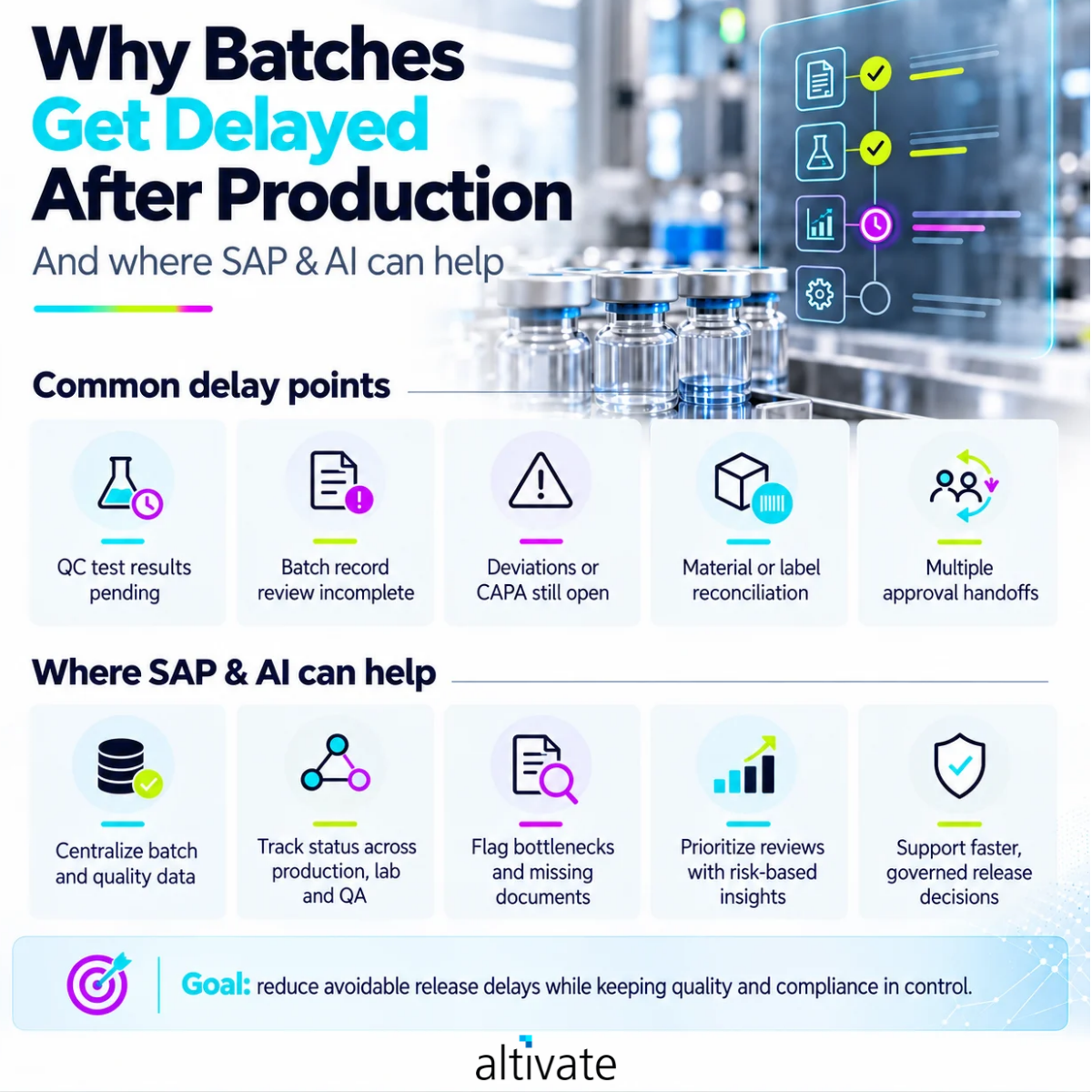
Four recurring sources of avoidable waiting deserve attention:
- Missing or late evidence: required results or supporting documents are unavailable when review begins.
- Manual reconciliation: batch identifiers, timestamps or quantities must be matched between manufacturing, quality and laboratory systems.
- Unresolved exceptions: deviations or discrepancies lack a clear owner, status or documented resolution.
- Approval handoffs: the evidence is ready, but the next reviewer has no reliable view of what is pending.
The goal is not to shortcut the required checks. It is to remove administrative friction so quality specialists can focus on actual quality risks.
What a connected SAP landscape can change
SAP S/4HANA Quality Management can support inspection processing and usage decisions, while the ERP backbone provides material, batch and inventory context. SAP Digital Manufacturing can help capture manufacturing execution and production traceability where those capabilities are implemented. Relevant laboratory information management systems (LIMS), quality-management applications and controlled document repositories can be integrated to make evidence easier to access and reconcile.
That distinction matters: an ERP usage decision or stock-status change is not, by itself, the formal regulatory certification or batch-release authorization. The authorized quality function—and a Qualified Person where the applicable regulatory framework requires one—retains responsibility under approved procedures.
A practical connected workflow might show a reviewer which test result is still missing, which deviation remains open and which batch record is awaiting a controlled approval. It should also preserve source links, role-based access, audit trails and the validated status of the underlying systems.
Where AI could help—and where it should not
SAP’s 2026 Industry AI direction includes autonomous regulated manufacturing and more connected, governed industry workflows. For pharmaceutical batch review, that points to promising scenarios rather than a claim that every capability is available as a standard, ready-to-deploy SAP feature.
Within a properly designed and validated environment, AI-assisted functions could help identify incomplete evidence, group routine exceptions for triage, or draft reviewer summaries that cite the original records. They could also help quality and operations teams study patterns in avoidable waiting across batches.
But a generated summary is not a release record, and an AI recommendation must not replace required quality assessment, documented approvals or regulatory controls. The design priority is traceability: reviewers need to know what evidence was used, where it came from and what still requires human judgment.
A practical pilot: start with ten recent batches
Rather than launching a broad automation project, begin by examining ten recently completed batches from one product family. Measure the interval between production completion and authorized disposition, then categorize the time spent waiting.
- Map the workflow: identify each record, owner, handoff and formal quality gate.
- Separate necessary review from avoidable waiting: tag missing results, open deviations, mismatched records, queue time and approval routing.
- Test one intervention: for example, a controlled exception worklist that identifies missing evidence before the review queue begins.
- Measure before and after: compare release-cycle time, first-pass record completeness, deviation aging and manual reconciliation effort without relaxing quality criteria.
A pilot is successful only if it improves visibility or efficiency while maintaining validation, data integrity and the quality team’s control over decisions.
The question for pharmaceutical leaders
Before investing in another dashboard or AI demonstration, ask: Where does our typical batch wait longest? Is that waiting essential to a defensible quality decision, or is it time lost searching, reconciling and routing? And which change would make the next batch easier to review without increasing compliance risk?
At Altivate, we help organizations connect SAP processes, enterprise data and operating decisions. For pharmaceutical manufacturers, the opportunity is to make quality information more coherent and usable—not to automate responsibility away from the people who hold it.
Learn more: https://www.altivate.com/industries/pharmaceutical-life-sciences/
Contact us: https://www.altivate.com/contact/