A system issue appears. A ticket is raised. The support team responds. The issue is resolved. The ticket is closed.
On paper, the process worked.
But for the business, the impact may have already happened.
A delayed approval. A disrupted workflow. A missed reporting deadline. A frustrated user. A slowed operation. A customer experience affected by internal inefficiency.
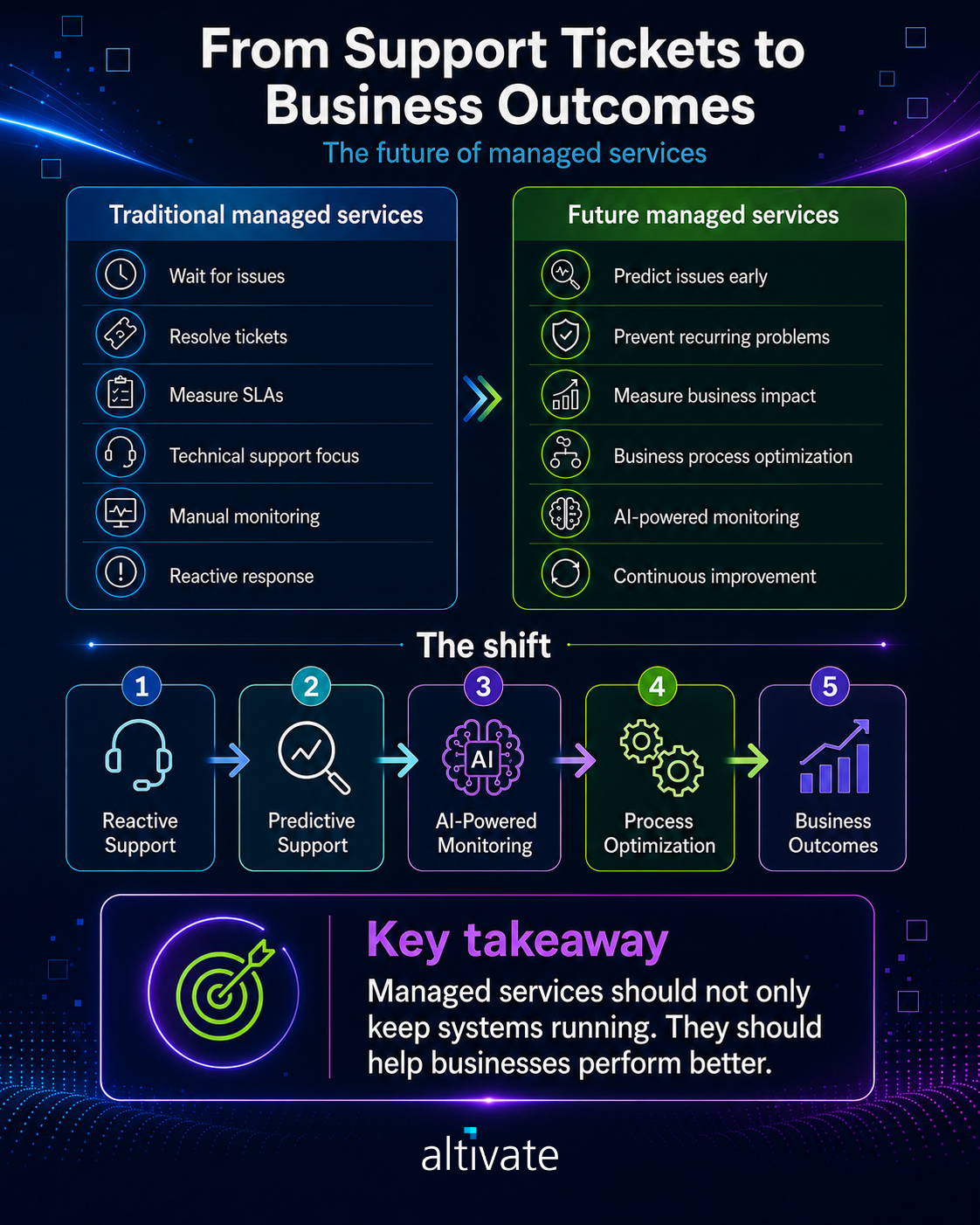
This is why the future of managed services can no longer be measured only by how quickly support tickets are closed. Businesses today need more than reactive support. They need managed services that help them prevent disruption, improve processes, increase visibility, and create measurable business value.
In an environment where enterprises rely on complex digital ecosystems, from ERP and cloud platforms to analytics, integrations, and business applications, support must evolve. It must move from fixing problems after they occur to helping organizations operate better every day.
The future of managed services is not only about keeping systems running.
It is about helping businesses perform better.
Why the Traditional Support Model Is No Longer Enough
For many years, managed services were mainly associated with technical support, incident handling, and application maintenance. The model was often simple: a user faces an issue, a ticket is created, a support team investigates, and the issue is resolved according to a defined service level agreement.
This model is still important. Businesses need reliable support. They need fast response times, stable systems, and clear escalation paths.
But ticket resolution alone does not always mean the business is improving.
A support team may close hundreds of tickets, while the same issues continue to appear month after month. A system may remain technically available, while users still struggle with inefficient workflows. A report may be fixed, while the data quality issue behind it remains unresolved.
In this kind of model, success is measured by activity rather than impact.
Modern businesses need a different approach. They need managed services that not only respond to issues, but also identify patterns, reduce recurrence, optimize business processes, and support continuous improvement.
This is where managed services are evolving from a support function into a performance enabler.
From Reactive Support to Predictive Support
One of the most important shifts in managed services is the move from reactive support to predictive support.
Reactive support waits for something to go wrong.
Predictive support looks for signs that something could go wrong and acts before the business is affected.
By analyzing system behavior, recurring incidents, performance trends, usage patterns, and process bottlenecks, managed service teams can identify risks earlier and take proactive action. This helps organizations reduce downtime, avoid repeated disruptions, and improve user experience.
For example, if a certain integration fails repeatedly at specific times, predictive support looks beyond the immediate incident. It investigates the pattern, identifies the root cause, and recommends a long-term fix. If a business process regularly slows down at a certain approval stage, the issue may not be only technical. It may require workflow optimization, user training, or process redesign.
This is the real value of predictive support. It changes the conversation from:
“How quickly can we fix this issue?”
to:
“How can we prevent this issue from happening again?”
That shift is critical for organizations that want to build more resilient and efficient operations.
AI-Powered Monitoring: Making Managed Services Smarter
As enterprise environments become more complex, manual monitoring alone is no longer enough.
Businesses today operate across cloud platforms, ERP systems, business applications, integrations, databases, analytics tools, and user interfaces. A single disruption can affect multiple departments and processes.
AI-powered monitoring helps managed services teams detect issues faster, understand system behavior more clearly, and prioritize what matters most.
With AI and automation, organizations can monitor performance, detect anomalies, identify unusual activity, and generate alerts before issues escalate. This reduces the dependency on manual checks and helps support teams respond with greater speed and accuracy.
AI can also help identify recurring patterns that may not be immediately visible to human teams. It can support root cause analysis, recommend corrective actions, and help prioritize incidents based on business impact rather than technical severity alone.
This is especially important because not all issues have the same business value.
A minor technical issue in one area may have limited impact. But a disruption in finance closing, procurement approvals, production planning, payroll processing, or customer order management may affect critical business operations.
AI-powered monitoring allows managed services to become more intelligent, proactive, and business-aware.
It helps support teams move from simply reacting to alerts to understanding what those alerts mean for the organization.
Business Process Optimization: The Real Value Beyond Technical Support
The future of managed services is not only technical. It is deeply connected to business process improvement.
A recurring support ticket may be a sign of a larger issue. It may point to a broken workflow, unclear ownership, poor master data, weak integration, low user adoption, or an inefficient approval process.
This is why managed services teams need to understand not only the system, but also the business process behind the system.
For example:
- A recurring procurement issue may reveal a supplier data problem.
- A finance reporting issue may reveal inconsistencies in master data or configuration.
- An HR system issue may reveal a gap in user adoption or workflow design.
- A supply chain delay may reveal an integration or process dependency that needs improvement.
In each case, the ticket is only the symptom. The real value comes from understanding and addressing the cause.
This is where managed services become a continuous improvement function. Instead of only keeping applications stable, they help organizations simplify workflows, remove friction, improve accuracy, and make better use of their digital investments.
Business process optimization turns managed services into a strategic capability. It ensures that enterprise systems continue to evolve with the business, rather than becoming static tools that only receive maintenance when something breaks.
Value-Driven AMS Models: Measuring What Really Matters
Application Management Services (AMS) must also evolve in how success is measured.
Traditional AMS models often focus on operational metrics such as number of tickets closed, response time, resolution time, and SLA compliance. These are useful metrics, but they do not tell the full story.
A value-driven AMS model looks beyond support activity and focuses on business outcomes.
It asks questions such as:
- Did we reduce recurring incidents?
- Did we improve system availability?
- Did we shorten process cycle times?
- Did we improve user adoption?
- Did we reduce manual work?
- Did we support better decision-making?
- Did we help the business operate more efficiently?
This shift changes the role of AMS from a technical support service to a business value partner.
In a value-driven model, success is not only about closing tickets faster. It is about reducing the need for tickets in the first place. It is about improving the quality of operations, increasing business continuity, and helping organizations extract more value from their enterprise platforms.
For businesses using SAP, cloud platforms, analytics solutions, and integrated enterprise applications, this approach is essential. The goal is not only to maintain the system. The goal is to continuously improve how the business runs through that system.
Why This Matters for Digital Transformation
Digital transformation does not end at go-live.
In many ways, go-live is only the beginning.
Once a new system, platform, or process is implemented, businesses need to ensure that it continues to support their changing needs. Users evolve. Business requirements change. New technologies emerge. Processes need refinement. Data volumes grow. Integrations become more complex.
Without the right managed services model, organizations risk treating digital transformation as a one-time project instead of an ongoing journey.
Modern managed services help businesses protect and extend the value of their technology investments. They ensure that systems remain stable, processes remain aligned, and improvements continue after implementation.
This is especially important in fast-changing markets, where organizations must be able to adapt quickly, operate efficiently, and make decisions based on reliable data.
Managed services are no longer only about system maintenance.
They are about continuous business enablement.
Altivate’s Approach to Managed Services
At Altivate, we believe managed services should do more than keep systems running. They should help businesses operate with greater visibility, resilience, and efficiency.
Our approach brings together enterprise application expertise, process understanding, cloud capabilities, AI-enabled thinking, and continuous improvement. This allows us to support organizations not only in resolving issues, but also in identifying opportunities to improve how their business works.
Through managed services and AMS support, Altivate helps clients move from reactive support to proactive value creation. This includes monitoring business-critical systems, improving operational stability, addressing recurring issues, supporting users, optimizing workflows, and aligning technology performance with business goals.
Because in today’s enterprise environment, support is not just about fixing what is broken.
It is about helping organizations become stronger, smarter, and more prepared for what comes next.
The Future Is Outcome-Driven
The future of managed services will not be defined by the number of tickets closed.
It will be defined by the value delivered.
Businesses need partners who can help them anticipate issues before they happen, monitor systems intelligently, optimize processes continuously, and measure success through outcomes that matter.
- From support tickets to business performance.
- From reactive response to predictive action.
- From technical maintenance to continuous optimization.
- From system support to value-driven partnership.
As businesses continue to modernize their operations, managed services will play a critical role in helping them sustain transformation, improve resilience, and elevate performance.
Because the future of AMS is not only about support.
It is about outcomes.