SAP Business Data Cloud (BDC) is, in SAP’s words, “a fully managed software-as-a-service (SaaS) solution that unifies and governs all SAP data.” SAP announced it on 13 February 2025. It brings together SAP Datasphere, SAP Analytics Cloud and SAP Business Warehouse, and includes SAP Databricks as a first-party data service.
Weighing cost, the Datasphere change and whether to pilot? Read our white paper first: SAP Business Data Cloud: A Decision Guide to Cost, Datasphere, AI and Adoption. This post is the plain-English explainer. It covers what is in the bundle, how it differs from Datasphere on its own, who should look at it, and what the path from BW looks like. Product facts are as of October 2026 and are drawn from SAP and partner sources; the TechEd 2026 section further down is dated 4 November 2026.
What is SAP Business Data Cloud (BDC)?
BDC is SAP’s attempt to turn a set of separate data and analytics products into one subscription with one foundation. Before BDC, a customer might run SAP Datasphere for data integration and modelling, SAP Analytics Cloud for reporting and planning, SAP BW or BW/4HANA for the warehouse, and a separate Databricks or Snowflake platform for data science. BDC packages the SAP pieces together, adds SAP-managed data products and prebuilt applications on top, and connects to third-party platforms without copying the data out.
SAP’s own architecture documentation lists three main reasons to adopt it:
- Moving to a business data fabric, with standardised data products and Intelligent Applications, plus extensions you build yourself.
- Modernising SAP BW and BW/4HANA systems for analytics and AI/ML.
- A unified platform for SAP and non-SAP data.
In May 2026 SAP described BDC as the data foundation of the SAP Business AI Platform and said SAP HANA Cloud and SAP Master Data Governance are now core components. SAP also said it has acquired Reltio and is bringing multi-domain master data management into BDC. That is a statement of direction, not a description of what every customer gets on day one.
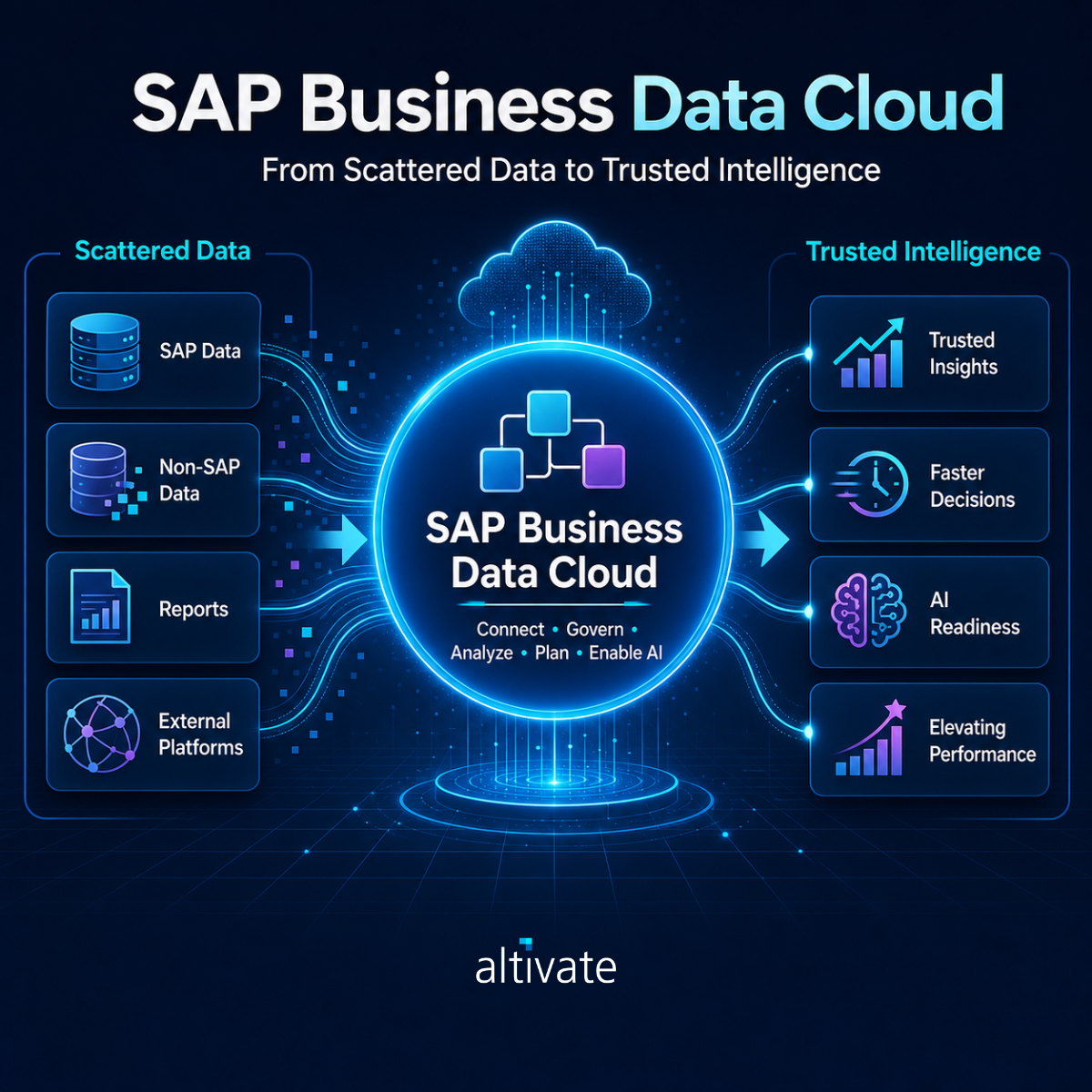
What is inside SAP BDC: the components
The table below lists the pieces customers ask about most. SAP has changed some names since the launch, so the naming column matters when you read older articles or proposals.
| Component | What it does in BDC | Naming and status note |
|---|---|---|
| SAP Datasphere | Modelling, integration, catalog and the data-sharing layer. SAP’s Architecture Center calls it the “centralized business data fabric” inside BDC. | One component of BDC, not the whole product. Joule in SAP Datasphere is generally available (SAP Business AI release highlights, Q1 2026). |
| SAP Analytics Cloud (SAC) | Dashboards, analytics and planning. Intelligent Applications are delivered as SAC stories on Datasphere models and views. | SAC planning needs a separate Enterprise Planning Cloud Service, per SAP’s service description guide (v9-2026). |
| SAP BW and BW/4HANA, private cloud edition (BW PCE) | Keeps existing BW content running in SAP’s cloud while you move use cases to data products over time. | The BW lift is the first step in SAP’s reference path (see the BW section below). |
| SAP Databricks | Embedded Databricks technology for data engineering, machine learning and AI inside BDC. | Generally available since 30 April 2025, on AWS first. SAP and Databricks later announced Google Cloud and Azure availability. Check release notes for your cloud and region. |
| Data products | Curated, self-contained collections of tables and business data, exposed through standardised APIs and described by metadata. SAP-managed data products are activated by the customer, while SAP handles extraction and loading. | Can also be customer-managed. Provisioned through the BDC Cockpit using “formations” that link data product providers with consumption components. |
| Insight Apps (SAP’s current documentation calls them Intelligent Applications) | Prebuilt analytical applications with predefined metrics, AI models and planning features. SAP lists People Intelligence as an example BDC application. | “Insight Apps” was the February 2025 launch term. Newer SAP technical and pricing documents say Intelligent Applications. Customers can copy and customise the underlying Datasphere models and SAC stories. |
| SAP HANA Cloud and SAP Master Data Governance | Named by SAP in May 2026 as core components of BDC. | SAP’s licensing briefings list MDG on an extra stack, so confirm what your contract includes. |
| BDC Connect | Zero-copy sharing between BDC and a customer’s own third-party data platform. | See the connector table below for status by platform. |
In practice, you work with these components through a formation: a set of BDC, SAC and Datasphere tenants with single sign-on between them. In our experience, it pays to plan tenant layout early.
SAP Business Data Cloud vs SAP Datasphere
This is the question behind many “what is SAP BDC” searches. The short answer: Datasphere is a part of BDC. BDC is the larger package built around it. For a practitioner view of the part, see our SAP Datasphere page.
| Question | SAP Datasphere on its own | SAP Business Data Cloud |
|---|---|---|
| Scope | Modelling, integration, catalog and data sharing. | Datasphere plus SAC, BW/BW PCE, SAP Databricks, SAP-managed data products, Intelligent Applications, the BDC Cockpit and formations. Per SAP’s May 2026 article, also HANA Cloud and MDG. |
| Prebuilt content | You model it yourself. | SAP-managed data products and Intelligent Applications, activated through the BDC Cockpit. |
| Data science and ML | Connect to a platform you run elsewhere. | SAP Databricks embedded, plus BDC Connect to your own Databricks. |
| Buying model | Historically bought under BTPEA, CPEA or pay-as-you-go. SAP says Datasphere is not available for renewal under those contracts after 31 December 2025. | A capacity-unit (CU) metered subscription, according to SAP User Group’s April 2026 briefing. |
One purchasing change matters if you already use Datasphere or SAC. SAP announced that both would be removed from the eligible services for new BTPEA, CPEA and pay-as-you-go contracts from 1 January 2026, and wrote that “after December 31, 2025, these services will not be available for renewal.” SAP also said existing terms run to their end, credits bought before 1 January 2026 stay usable, and tenants are preserved with no technical migration. SAP’s BDC FAQ on the SAP Community adds that SAP handles the “rewiring” into BDC for SAP-managed tenants through a restructuring contract, while customer-managed tenants are rewired by the customer. That FAQ is a community post, not contract language, so check it against your own agreement. SAP’s launch announcement also states that existing Datasphere customers’ “investments remain fully supported.”
SAP BDC and enterprise data management
Teams searching for “SAP enterprise data management” usually want to know where integration, cataloguing, governance and master data sit. In BDC they are spread across components:
- Integration and replication: Datasphere replication flows bring non-SAP sources in, and SAP-managed data products replace standard DataSources for SAP sources, with SAP handling extraction and loading.
- Catalog and metadata: data products carry business metadata, so consumers can find and understand them.
- Master data: SAP Master Data Governance is named as a core component as of May 2026, and SAP says multi-domain master data management from its Reltio acquisition is coming into BDC.
- Delivery and access: the BDC Cockpit provisions data products and applications, and SAP HANA Cloud can consume BDC data products without replication.
BDC is not a replacement for your data governance operating model. Ownership, definitions and quality rules still need people to own them. The platform makes those decisions easier to enforce, but it does not make them for you.
Not sure where BDC fits in your landscape?
A BDC readiness assessment maps your current SAP and non-SAP data estate, your BW and Datasphere position, and the contract and data residency questions to settle before a pilot.
The Databricks partnership and third-party connectors
There are two different Databricks routes, and proposals often blur them. SAP Databricks is embedded inside BDC. BDC Connect for Databricks shares data, with no copying, between BDC and a Databricks workspace you already own. SAP Databricks went generally available on 30 April 2025. BDC Connect for Databricks reached general availability on 6 October 2025 on all clouds, using Delta Sharing and Unity Catalog with mTLS and OAuth.
Other platforms have their own connectors, with different maturity:
| Platform | Status as of October 2026 |
|---|---|
| Databricks (your own workspace) | Generally available since 6 October 2025. |
| Snowflake | Snowflake’s zero-copy connector went generally available on 4 May 2026. SAP announced general availability of SAP Snowflake and BDC Connect for Snowflake on 25 May 2026. SAP’s Community post says there is no discrete data-sharing fee, though infrastructure fees apply. |
| Google BigQuery | BDC Connect for BigQuery generally available on 28 July 2026, per Google Cloud. |
| Microsoft Fabric | Announced 18 November 2025. SAP now plans general availability for the end of Q1 2027, subject to change. Treat this as a plan. |
| Athena (AWS) | Announced 13 May 2026, with general availability planned for the second half of 2026. Treat this as a plan. |
How SAP Business Data Cloud supports AI
AI projects usually stall on data, not models. BDC addresses that in a few concrete ways:
- Governed inputs. Data products carry business metadata, so models and agents work from defined business objects instead of raw tables.
- Model training and serving. SAP’s reference architecture shows patterns with SAP AI Core and the Generative AI Hub, including AI-enhanced data products and model training in Databricks with serving in AI Core.
- Joule. Joule in SAP Datasphere is generally available. SAP has announced Joule Agents in BDC for data product search and creation, conversational data management, analytics and planning, but has stated no general availability dates. Treat those as announced capabilities. At SAP Connect on 6 October 2026, SAP said BDC and its Knowledge Graph ground agents, again without feature dates.
Do not buy BDC because of an agent that is not yet shipping. Buy it if the data foundation, the data products and the governance model are what your AI roadmap is missing.
After TechEd 2026: what is generally available, in beta or still planned for BDC
SAP announced new lakehouse and business data fabric capabilities for SAP Business Data Cloud at SAP TechEd Berlin, in a SAP News Center post on lakehouse and data fabric innovations dated 29 October 2026 and in the SAP TechEd 2026 press release dated 27 October 2026. The status labels below are as of 4 November 2026 and are taken from SAP’s TechEd Innovation News Guide 2026. Where SAP’s news posts word things more strongly than the guide, we use the guide’s label. The last two rows come from SAP’s TechEd news posts and do not appear in the guide.
| Item | Status per SAP (4 Nov 2026) | What it means for a BDC plan |
|---|---|---|
| Joule Studio integration with SAP Business Data Cloud | Planned, GA Q1 2027 | Do not design a data product workflow that depends on creating or consuming data products inside Joule Studio until SAP confirms Q1 2027 delivery. |
| SAP Business Data Cloud Ontology Manager | Beta planned for November 2026 (not GA, no GA date) | If SAP offers you beta access, use it to evaluate, but keep ontology-driven agent behaviour out of a production design, because SAP gives no general availability date. |
| Lakehouse capabilities (native Apache Iceberg, distributed SQL query engine, Dremio) | Planned, GA Q1 2027 | Wait for Q1 2027 before designing Iceberg-based storage or query patterns on BDC. |
| SAP Reltio data product capabilities | Planned, GA Q1 2027 | Scope with SAP what “available” covers before you put Reltio data products into a master data plan (see the wording note below). |
| SAP Knowledge Graph: customer-specific context feeding Joule | Planned, GA Q1 2027 | Keep Joule context work at pilot stage and avoid committing to agent outcomes that assume customer-specific Knowledge Graph context. |
| SAP Sovereign Cloud on AWS adds SAP AI Core, Joule and SAP Datasphere | Planned, GA Q4 2026, in the United Kingdom, Australia and Canada only | Plan nothing for Saudi Arabia or the UAE on the strength of this item: the guide names no GCC country. |
| Joule Work and Joule Studio | GA underway, phased | Adopt against SAP’s phased schedule rather than assuming a single switch-on date for your tenant. |
| Joule agentic capabilities in SAP HANA Cloud for DBAs | Planned, GA Q4 2026 | Keep DBA agent automation out of scope for now and revisit once Q4 2026 has passed and SAP confirms delivery. |
| Expanded SAP Databricks (Lakeflow, Agent Bricks, Unity Gateway, Lakebase) | Announced in SAP’s TechEd news; not in the guide, no date given | Do not schedule a Databricks feature comparison or migration on the basis of these items until SAP dates them. |
| SAP Application Data Foundation | Announced in SAP’s TechEd news; not in the guide, no date given | Note it as a possible route for exposing SAP application data into your BDC engine of choice, and plan nothing until SAP gives a date. |
Where SAP’s wording differs. For Reltio, SAP’s 29 October news post says “SAP Reltio is now generally available in SAP BDC”, while the guide lists Reltio data product capabilities as planned for Q1 2027. For Apache Iceberg, the news post says BDC now supports native Apache Iceberg and a universal catalog powered by Apache Polaris, while the guide puts lakehouse capabilities at Q1 2027. In both cases we use the guide’s label; confirm scope with SAP before relying on either.
What to do with this
- Treat every Q1 2027 item in the table as roadmap, not delivery, and do not let it anchor a business case.
- The guide does not mention the Microsoft Fabric connector (planned for the end of Q1 2027) or Athena (planned for the second half of 2026), so the connector table earlier in this post still stands.
- Ask SAP in writing about availability in Saudi Arabia and the UAE, because none of these items is stated for either country.
- Revisit this section when SAP updates the guide, since these labels are a point-in-time reading dated 4 November 2026.
Joule Work and Joule Studio general availability is underway in a phased rollout per the guide; for how Joule agents and agent-to-agent patterns work see our SAP Joule Agents page and our post on a Joule multi-agent pilot.
Who should consider SAP BDC
BDC is most relevant to organisations in one of these positions:
- Running SAP BW or BW/4HANA and deciding what comes next. BDC gives a staged path, covered in the next section.
- Running S/4HANA or RISE with SAP. SAP Help documents that S/4HANA Cloud Private Edition makes data products available to BDC Intelligent Applications (see “Integration with SAP Business Data Cloud”, S/4HANA 2025 FPS02). That makes an S/4HANA landscape a natural starting point.
- Already on Datasphere or SAC and facing the contract change described above.
- Combining SAP and non-SAP data on a platform such as Databricks, Snowflake or BigQuery, and wanting to avoid copying SAP data out.
It is a weaker fit if you have no SAP core, a small reporting estate that SAC alone handles, or a data platform strategy already settled on another vendor. In those cases a smaller pilot, or no move, can be the right answer. The decision guide lays out when to review, pilot or wait.
The migration path from SAP BW to BDC
SAP’s reference architecture gives BW customers a three-step path: lift, shift, innovate. SAP says customers can gradually shift BW use cases “instead of spending time and budget on a migration.” That is SAP’s framing, and your own effort will depend on how much custom BW logic you carry.
| Step | What happens | Prerequisites and notes |
|---|---|---|
| 1. Lift | Move BW NetWeaver or BW/4HANA to SAP Business Warehouse, private cloud edition (BW PCE). | BW 7.5 on HANA at SPS24 or later. BW/4HANA 2021 at SPS04 or later. BW/4HANA 1.0 and 2.0 upgrade to BW/4HANA 2023 at the latest support package. |
| 2. Shift | Use the Data Product Generator for SAP Business Data Cloud to publish InfoProvider data to the Datasphere object store as BW data products. They can be delta-shared to SAP Databricks. | The BW system must run in the private cloud environment in BDC. SAP notes the object store is “not a cold store alternative.” |
| 3. Innovate | Consume SAP-managed data products and Intelligent Applications, and retire BW use cases as replacements land. | BW queries and CompositeProviders become Datasphere analytic models and views. BW transformations become transformation flows. Standard DataSources are replaced by SAP-managed data products. Non-SAP sources come in through replication flows. |
On timing, SAP’s Architecture Center says BW NetWeaver lifted to BW PCE keeps maintenance until the end of 2030, and BW/4HANA PCE keeps maintenance until 2040. Separately, SAP Community stated in 2020 that BW 7.5 mainstream maintenance ends on 31 December 2027, extended to the end of 2030 at a premium, with BW/4HANA maintained to at least 2040. Check the current SAP maintenance terms for your release before you plan around any of these dates.
SAP’s total cost pitch for this path, which is a vendor claim, is that there is no migration cost for the BW/4HANA upgrade and a lower Datasphere premium outbound cost through zero-copy. Test it against your own volumes. A sensible first move is an inventory of BW content: which queries are actually used, which carry custom logic, and which can simply be switched off.
Licensing and cost model
According to SAP User Group’s 16 April 2026 briefing, BDC core is a subscription metered in capacity units (CU). Core covers Datasphere, SAC, BW Cloud, HANA Cloud, BDC Connect and SAP Databricks, with Master Data Governance on an extra stack. The same briefing says core is sold with at least one Intelligent Application or package, as of April 2026, so re-check that with SAP. SAP’s service description guide (v9-2026) says measurement is on the peak month, with no proration or carry-over for the listed capacity tables. In short, it is consumption-based and measured monthly.
We have not found a public price per CU, so we do not quote one here. Some things worth asking before you sign:
- Which components are in core, and which need a separate service such as SAC Enterprise Planning?
- Is an Intelligent Application mandatory for your package?
- How are existing Datasphere, SAC or BW commitments credited?
- Do you need RISE with SAP or Cloud ERP Private for the applications you want? SAP’s guide says Cloud ERP Intelligence Private does.
The white paper covers these questions in more detail: SAP Business Data Cloud decision guide.
Benefits of SAP Business Data Cloud, and what to check in the Gulf
The benefits that hold up in practice are structural: fewer copies of SAP data, business meaning carried with the data through data products, one place to govern access, and a defined route off BW. BDC does not fix poor source data, undefined KPIs or missing ownership.
For organisations in Saudi Arabia and the UAE, region availability is the first thing to verify. Databricks documentation (15 October 2026) lists SAP Databricks in 19 regions, none in Saudi Arabia or the UAE. SAP’s BDC FAQ (13 July 2026) names AWS, Google Cloud and Azure as hosting options and says regions are on the roadmap, without a region list. Google’s BigQuery connector announcement lists Dammam among BDC regions on Google Cloud, which is a Google claim. Confirm region and data residency with SAP in writing before you commit.
Then match the answer to your regulator. These are questions to ask, not legal conclusions:
- Saudi Arabia: how do the NCA cloud controls (CCC-2:2024), the SAMA Cyber Security Framework cloud approval requirements (with their in-Kingdom principle) and the Saudi PDPL apply to the data you would move?
- UAE: how does the UAE PDPL (in force since 2 January 2022) apply, and, if you are CBUAE-regulated, does Central Bank of the UAE Operational Risk Regulation C 1/2026 (effective 14 September 2026) affect where the master system of record must sit?
Where Altivate fits
Altivate is an SAP Gold Partner and is certified to ISO/IEC 27001 and ISO/IEC 42001, the AI management standard. We help clients decide whether BDC suits them, then plan the work. That usually means a BW and Datasphere inventory, a data product shortlist, contract and region questions for SAP, and a pilot scope. Our technology pages cover SAP Business Data Cloud, SAP Datasphere and SAP Analytics Cloud. For the planning side, see our post on SAP Analytics Cloud and data-driven decisions.
Frequently asked questions
What is SAP Business Data Cloud?
SAP Business Data Cloud is a fully managed SaaS solution that SAP says unifies and governs all SAP data. It brings together SAP Datasphere, SAP Analytics Cloud and SAP Business Warehouse, includes SAP Databricks, and adds SAP-managed data products and prebuilt applications.
What does SAP BDC stand for?
BDC stands for Business Data Cloud. “SAP BDC” and “SAP Business Data Cloud” refer to the same product.
Is SAP Business Data Cloud the same as SAP Datasphere?
No. Datasphere is one component of BDC, covering modelling, integration, catalog and data sharing. BDC adds SAC, BW, SAP Databricks, data products and Intelligent Applications, with HANA Cloud and Master Data Governance named as core components by SAP in May 2026.
Does SAP BDC replace SAP BW?
SAP positions BDC as a path for BW, not a forced replacement. Customers can lift BW to BW PCE, publish BW data as data products, and shift use cases gradually. BW NetWeaver on BW PCE keeps maintenance until the end of 2030, and BW/4HANA PCE until 2040, according to SAP’s Architecture Center.
What are Insight Apps in SAP BDC?
Insight Apps are prebuilt analytical applications with predefined metrics, AI models and planning features. SAP’s current documentation calls them Intelligent Applications. They are delivered as SAC stories on Datasphere models, which customers can copy and customise.
What is a data product in SAP BDC?
A data product is a curated, self-contained collection of tables and business data, exposed through standardised APIs and described by metadata. It can be SAP-managed, where the customer activates it and SAP handles extraction and loading, or customer-managed.
How is SAP Business Data Cloud priced?
BDC core is a capacity-unit metered subscription, measured monthly, according to SAP User Group’s April 2026 briefing and SAP’s service description guide. We have not found a public price per unit, so ask SAP for a written quote that lists the components it covers.
How does SAP Business Data Cloud support AI?
It gives AI governed, business-contextualised data through data products, embeds Databricks for model work, and supports patterns with SAP AI Core. Joule in Datasphere is generally available. Joule Agents in BDC were announced without dates; SAP’s TechEd 2026 guide now lists the Joule Studio integration with BDC as planned for general availability in Q1 2027.
What did SAP announce for BDC at TechEd 2026?
SAP announced new lakehouse and business data fabric capabilities for BDC at SAP TechEd Berlin. Per SAP’s TechEd Innovation News Guide, as read on 4 November 2026, SAP Business Data Cloud Ontology Manager is planned for beta in November 2026, and general availability of the Joule Studio integration with BDC, the lakehouse capabilities (Apache Iceberg support and a distributed SQL query engine) and SAP Reltio data product capabilities is planned for Q1 2027. The dated status table above sets out each item and what it means for a plan.
Can SAP BDC connect to Snowflake, BigQuery or Databricks?
Yes. As of October 2026, BDC Connect for Databricks, Snowflake and BigQuery are generally available. Microsoft Fabric is planned for the end of Q1 2027, and Athena for the second half of 2026, both subject to change.
Is SAP BDC available in Saudi Arabia and the UAE?
Not confirmed by the sources we reviewed. SAP Databricks lists no region in either country, and SAP names no region list in its FAQ. Google claims Dammam as a BDC region on Google Cloud only. Confirm availability and data residency with SAP before committing.
Do existing Datasphere customers have to move to BDC?
SAP says existing Datasphere customers’ investments remain fully supported. From 1 January 2026, Datasphere and SAC are not available for renewal under BTPEA, CPEA or pay-as-you-go contracts, so check your contract end date and your renewal route with SAP.
Ready to test whether BDC fits?
Altivate runs a BDC readiness assessment: your BW and Datasphere inventory, a data product shortlist, and the contract and residency questions to settle with SAP before a pilot.