Recruiting is evolving quickly.
Many organizations have long relied on SAP SuccessFactors Recruiting to manage job openings, candidate applications, approvals, and hiring workflows. It has played an important role within the broader SAP HR landscape.
Now, however, the recruiting conversation is changing.
With SmartRecruiters becoming a more strategic part of SAP’s talent acquisition direction, and Winston introducing an AI-powered layer to support recruiting tasks, companies need to understand what is changing, what stays the same, and how to prepare.
For readers who are new to this topic, the most important point is simple:
Employee Central remains the HR foundation. SmartRecruiters modernizes recruiting. Winston adds AI-powered intelligence.
What Is Changing?
Traditionally, SAP SuccessFactors Recruiting has helped companies manage the recruitment process inside the SAP ecosystem. It supports requisitions, candidate tracking, approvals, and hiring workflows.
But today’s hiring environment demands more.
Recruiters are expected to move faster. Candidates expect a smoother experience. Hiring managers want better visibility. Leadership teams want stronger reporting and better hiring decisions.
This is where SAP’s recruiting direction is evolving.
Instead of relying only on traditional recruiting tools, organizations are now seeing a model where:
- SAP SuccessFactors Employee Central remains the system of record for core HR data
- SmartRecruiters provides a more modern recruiting experience
- Winston introduces AI capabilities to improve recruiting efficiency and decision-making
This direction became more significant following SAP’s acquisition of SmartRecruiters, which reinforced SAP’s focus on bringing more modern, AI-enabled talent acquisition capabilities into the SuccessFactors HCM ecosystem.
This is not just a product change. It is a shift toward a more connected, intelligent, and candidate-focused talent acquisition model.
The Three Parts Explained Simply
To understand the topic clearly, it helps to separate the three key components.
1. Employee Central: The HR Core
SAP SuccessFactors Employee Central is the core HR system.
It stores key employee and organizational information such as jobs, positions, departments, locations, and people data. In simple terms, it is the foundation that supports the wider HR landscape.
Think of Employee Central as the source of truth for HR data.
2. SmartRecruiters: The Modern Recruiting Platform
SmartRecruiters is the modern recruiting experience layer.
It focuses on the front end of talent acquisition, meaning the actual hiring experience for recruiters, candidates, and hiring managers. This includes areas such as sourcing, engagement, hiring workflows, collaboration, and recruiting experience.
In simple terms, SmartRecruiters helps make recruiting more flexible, modern, and user-friendly.
3. Winston: The AI Layer
Winston is the AI layer.
Rather than being a separate HR system, Winston adds intelligence to recruiting activities. It can help support tasks such as candidate matching, scheduling, automation, analytics, and recruiter productivity.
This is an important point because it means AI can start adding value even before a full system transition happens.
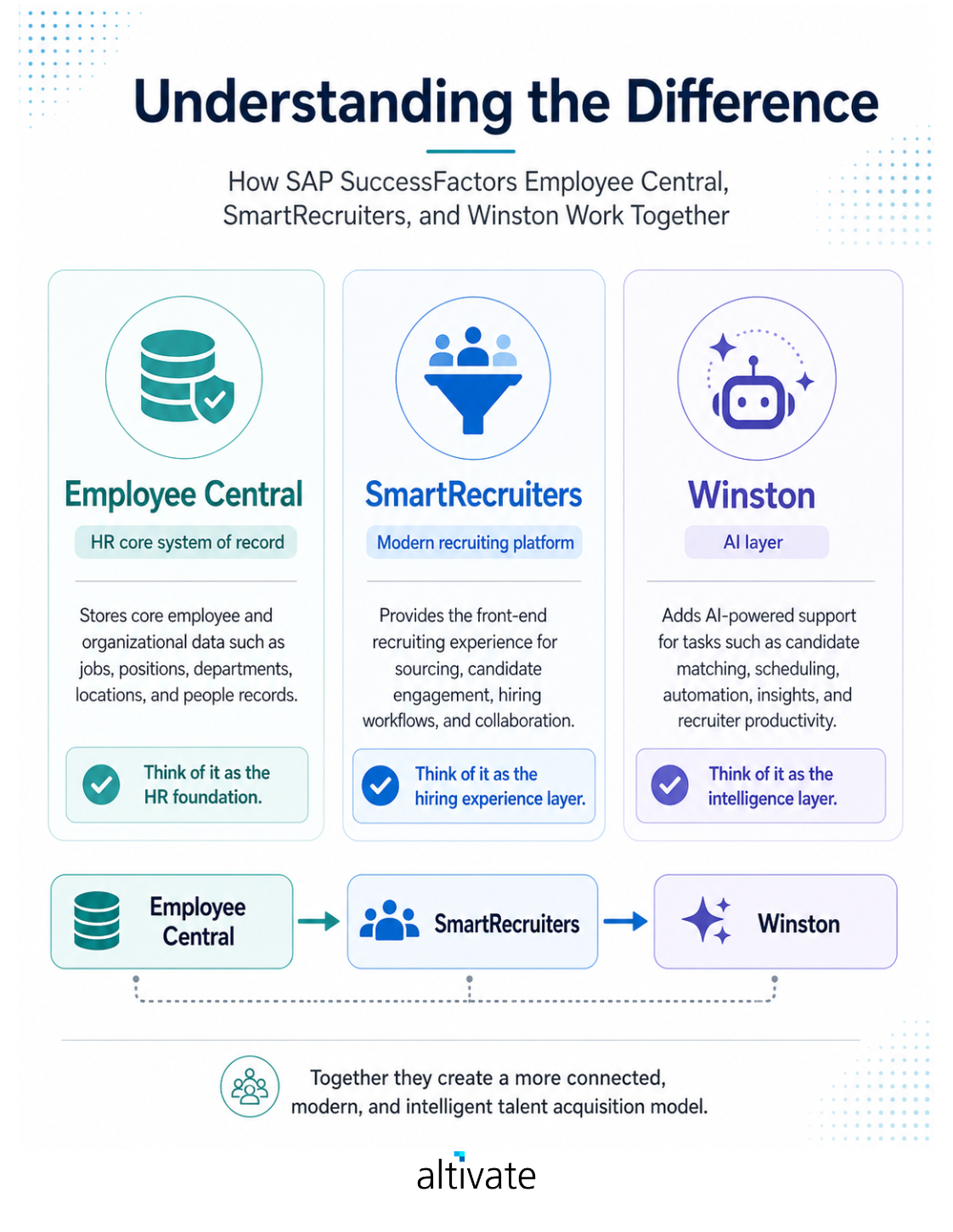
So if we simplify the model:
- Employee Central = HR foundation
- SmartRecruiters = hiring experience layer
- Winston = intelligence layer
Why This Matters for Existing SAP SuccessFactors Customers
This topic matters especially for companies already using SAP SuccessFactors Recruiting.
Many customers are asking:
- Do we need to replace our current recruiting setup?
- Can we still use SAP SuccessFactors while adopting newer capabilities?
- What role does AI play?
- What should we prepare now?
The answer is that companies do not need to think about this as an immediate full replacement.
Instead, they should view it as a strategic shift.
Organizations can keep Employee Central as the core HR system while gradually exploring how SmartRecruiters and Winston can improve recruiting outcomes.
That means the right question is not only, “What are we replacing?”
It is also, “How can we improve recruiting step by step?”
Where Winston Can Add Real Value
One of the strongest parts of this shift is the introduction of AI through Winston.
For many HR teams, AI can sound abstract or overly technical. But in practice, the value is quite straightforward.
Winston can help by improving everyday recruiting work, such as:
- Supporting candidate matching
- Reducing manual scheduling effort
- Helping recruiters prioritize tasks
- Improving reporting and insights
- Enhancing candidate engagement
- Reducing repetitive administrative work
This is why Winston is important. It brings the AI angle into recruiting in a practical way.
Instead of changing everything at once, organizations can start by identifying quick wins where AI can solve real pain points.
For example, if scheduling takes too much time, AI may help streamline that process. If recruiters struggle to identify top candidates efficiently, AI can support matching and prioritization. If reporting is weak, AI-driven insights can help improve visibility.
AI Is Not Replacing Recruiters
It is also important to address a common concern.
AI in recruiting is not about replacing recruiters or removing the human side of hiring.
Recruiting still depends on human judgment, communication, empathy, and cultural understanding. AI simply helps reduce repetitive work and gives teams better support.
In other words, AI helps recruiters spend less time on administration and more time on meaningful hiring activity.
That is why Winston should be seen as an enablement tool, not a replacement for people.
What Customers Should Review Now
For organizations already using SAP SuccessFactors, this is a good time to review their current recruiting landscape.
A few key areas should be assessed:
Current recruiting processes
Are workflows smooth and efficient, or are there delays and manual bottlenecks?
Candidate experience
Is the hiring journey clear, modern, and easy for candidates to navigate?
Recruiter productivity
Are recruiters spending too much time on repetitive tasks?
Reporting and insights
Do HR leaders have the information they need to improve hiring decisions?
Data quality
Is Employee Central data accurate, complete, and ready to support better integration?
This last point is especially important.
Why Data Readiness Matters
AI and integration both depend on good data.
If information in Employee Central is incomplete, outdated, or inconsistent, then even the best recruiting tools may not work as well as expected.
For example, issues with job data, position data, departments, locations, or organizational structure can create problems in reporting, recruiting workflows, and integration.
That is why organizations should make sure their HR foundation is clean and reliable before expanding AI-driven recruiting capabilities.
Put simply:
Better data leads to better recruiting and better AI outcomes.
A Practical Path Forward
The good news is that companies do not need to approach this as one large transformation all at once.
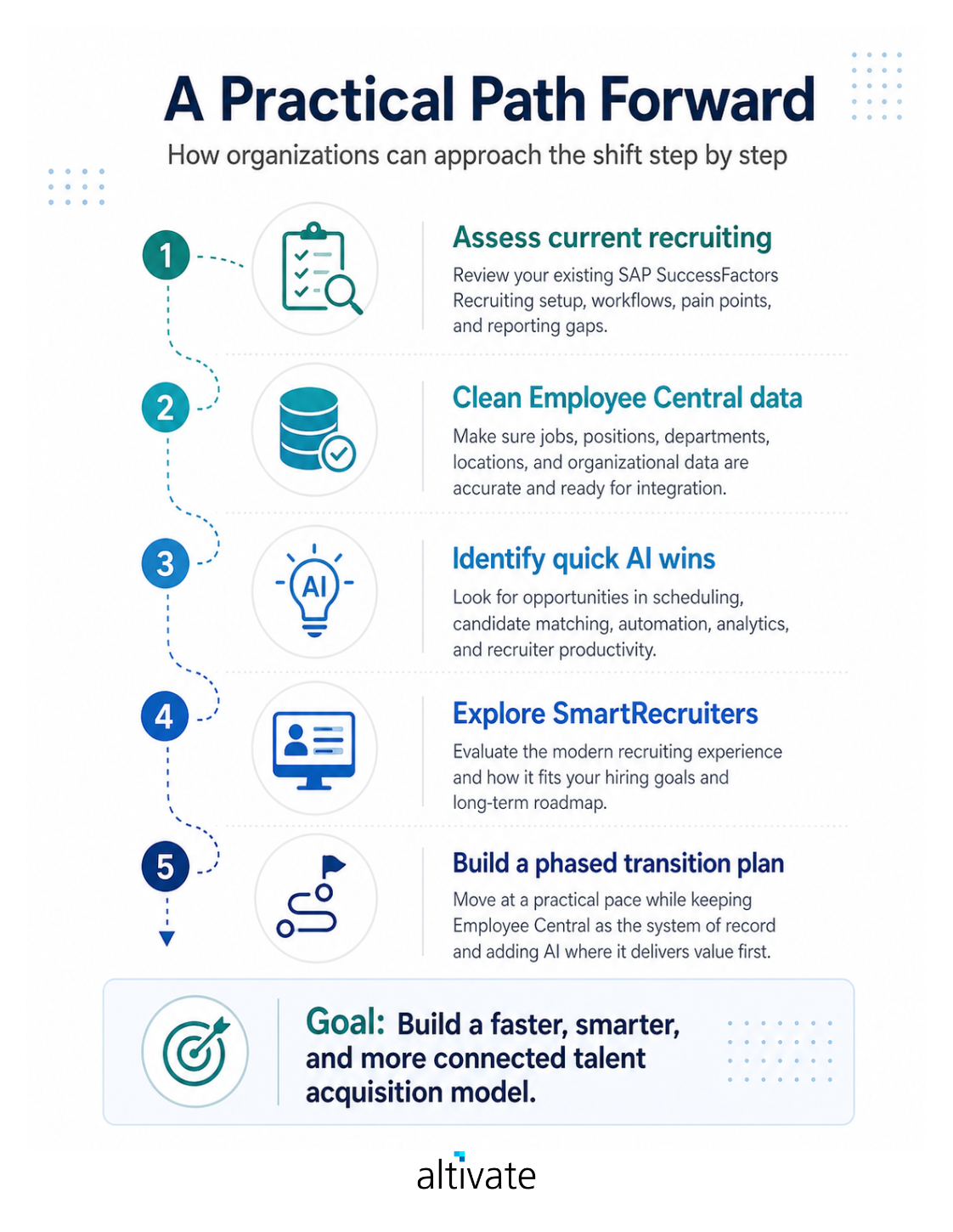
A more practical roadmap looks like this:
1. Assess the current setup
Review the existing SAP SuccessFactors Recruiting environment, pain points, workflows, and reporting gaps.
2. Clean Employee Central data
Make sure the HR foundation is accurate and ready for integration and future improvement.
3. Identify quick AI wins
Look for areas where Winston can help first, such as scheduling, matching, analytics, or recruiter productivity.
4. Explore SmartRecruiters
Evaluate how a more modern recruiting platform could fit business needs and long-term hiring goals.
5. Build a phased transition plan
Move at a practical pace while keeping Employee Central as the system of record and introducing innovation where it delivers value first.
This approach is often more realistic and easier for both HR and IT teams to manage.
How Altivate Can Help
As organizations look at the future of recruiting, they need more than product knowledge. They need a roadmap.
Altivate can help organizations:
- Assess their SAP SuccessFactors Recruiting setup
- Review Employee Central data readiness
- Identify Winston AI use cases
- Evaluate SmartRecruiters readiness
- Plan integration needs
- Redesign recruiting processes
- Support change management and user adoption
- Build a practical HR transformation roadmap
The goal is not only to adopt new tools. It is to help organizations create a more connected, efficient, and future-ready talent acquisition model.
Final Thoughts
The future of recruiting in the SAP ecosystem is becoming clearer.
Employee Central remains the HR core.
SmartRecruiters modernizes the recruiting experience.
Winston adds AI-powered intelligence.
Together, they represent a shift from traditional recruiting administration to a smarter and more connected approach to talent acquisition.
For existing SAP SuccessFactors customers, now is the right time to review current processes, improve data quality, identify AI opportunities, and plan for the future in a phased and practical way.
Organizations do not need to change everything overnight. But they do need to start understanding where recruiting is heading, and how to prepare for it.
Altivate helps organizations navigate this shift with the SAP SuccessFactors expertise, integration knowledge, and transformation experience needed to move forward with clarity and confidence.