One store is discounting products to clear excess inventory. Another store, sometimes in the same city, is losing sales because those exact products are unavailable.
Both situations may be happening within the same retail network, even when the business has enough stock overall.
This is one of retail’s most frustrating inventory challenges. The problem is not always how much merchandise a retailer owns. It is whether that merchandise is in the right location, in the right quantity, at the right time, and visible to the people making decisions.
For retailers managing physical stores, e-commerce platforms and regional distribution networks, improving inventory visibility and allocation can protect margins just as effectively as increasing sales.
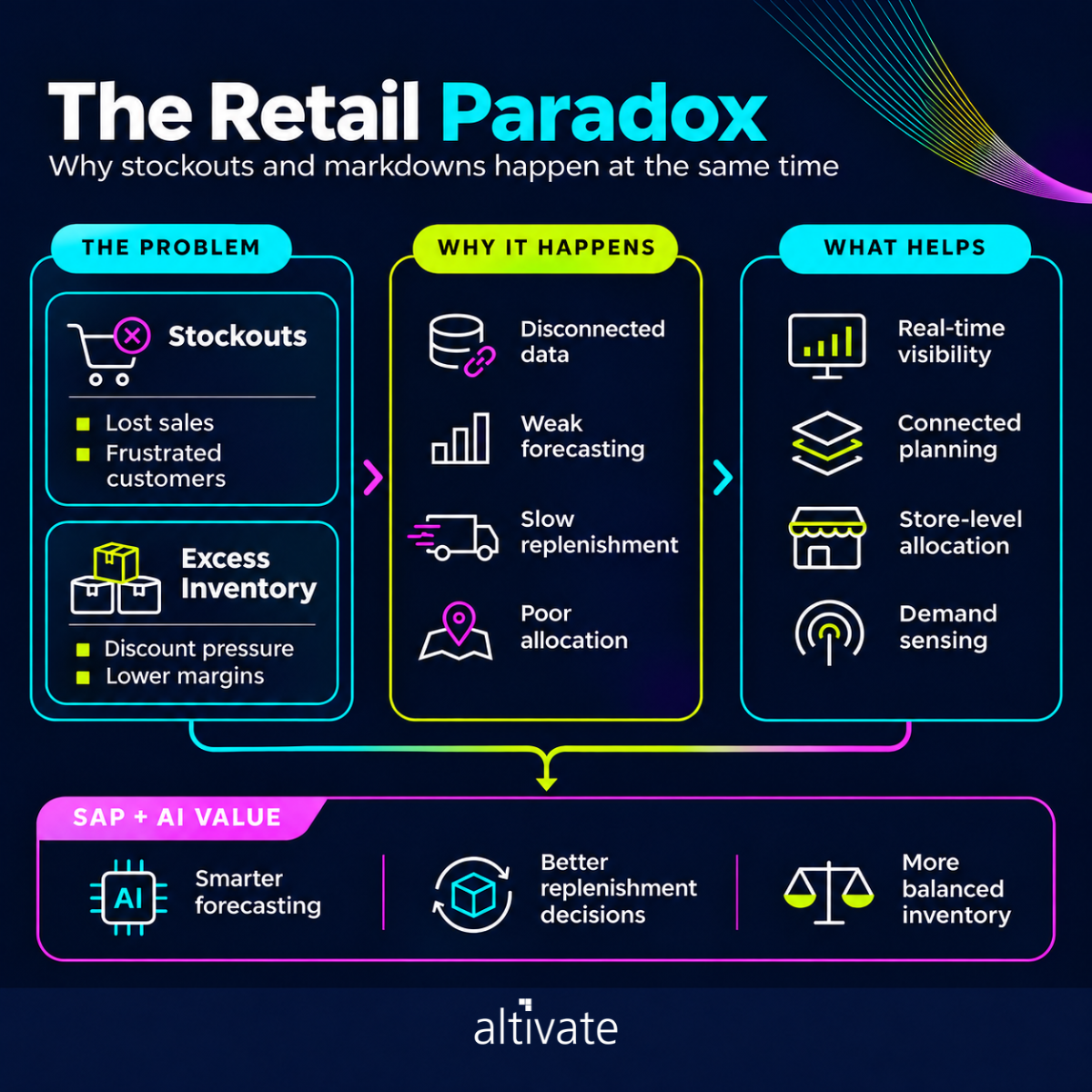
Why stockouts and markdowns happen at the same time
Retail inventory decisions involve more than forecasting total demand. A product that sells quickly in one location may move slowly in another. Customer preferences, store formats, local events and seasonal demand can all influence purchasing patterns.
Four common disconnects explain why inventory imbalances persist:
- Forecasts that overlook local demand: Purchasing and replenishment decisions may rely on chain-wide averages rather than demand patterns at individual stores or product-variant levels.
- Fragmented inventory visibility: Store systems, warehouses and e-commerce platforms may not share sufficiently current information about available, reserved or in-transit stock.
- Slow allocation decisions: Merchandise remains in low-demand locations while higher-demand stores wait for replenishment, even when a transfer might be feasible.
- Markdown decisions made in isolation: Products are discounted based on local aging or clearance targets without first evaluating demand elsewhere in the network.
These problems become more pronounced during Ramadan, Eid, back-to-school periods and other seasonal shopping peaks, when demand can shift quickly between locations and channels.
The outcome is a costly contradiction: excess inventory and lost sales occurring simultaneously.
The hidden cost goes beyond unsold merchandise
Markdowns are sometimes necessary. Fashion seasons end, products age, and retailers need to free space for new collections.
But a discount applied too early can sacrifice margin that might have been preserved through better stock allocation.
Stockouts carry a different cost. When customers cannot find a product in-store or online, they may choose an alternative, visit a competitor or abandon the purchase entirely.
The challenge is compounded when systems record historical sales without fully accounting for periods when products were unavailable. A store that repeatedly sells out may appear to have lower demand than it actually does, because transactions cannot capture every missed purchase.
Without this distinction, replenishment models risk repeating the same allocation mistakes.
Retail inventory optimization therefore requires more than accurate stock counts. It requires connecting demand, availability, replenishment, pricing and fulfillment economics.
How SAP connects inventory and demand decisions
A connected SAP retail landscape can help organizations move from fragmented stock reports toward coordinated planning and execution.
Different solutions contribute to different parts of the challenge.
SAP S/4HANA and SAP for Retail: The operational foundation
SAP S/4HANA, with the relevant retail capabilities, supports core merchandise, purchasing, inventory and financial processes.
Connecting store, warehouse and commercial transactions provides the operational foundation for understanding where merchandise is held, how it moves and what it costs.
SAP Customer Activity Repository: A clearer view of retail demand
SAP Customer Activity Repository (SAP CAR) consolidates transactional information from multiple sales channels. Its inventory visibility capabilities can combine ERP stock information with point-of-sale activity to provide a more current picture of inventory.
SAP’s Unified Demand Forecast capabilities also support forecasting that considers factors such as seasonality, promotions and historical purchasing patterns.
This helps retailers move beyond interpreting sales history as a complete picture of demand.
SAP Allocation Management: Putting stock where demand exists
SAP Allocation Management, available within the SAP Customer Activity Repository applications bundle, supports determining which stores should receive merchandise and in what quantities.
Using demand forecasts, product availability and business constraints, allocation planning can improve initial distribution and in-season replenishment.
SAP Integrated Business Planning: Looking across the supply network
For retailers with more complex supply chains, SAP Integrated Business Planning (SAP IBP) can support demand planning and inventory optimization across multiple locations and stages of the network.
Its inventory optimization capabilities consider factors including demand variability, lead times, supply uncertainty and target service levels.
These solutions are complementary, not interchangeable. Their suitability depends on the retailer’s architecture, deployment model and licensed capabilities.
Where AI can make retail decisions smarter
The next opportunity is not simply predicting which products will sell. It is helping planners understand which action makes the most commercial sense when conditions change.
AI-supported forecasting and analytics can help retailers:
- Identify unusual shifts in demand before they become widespread stockouts.
- Highlight products at risk of excess inventory or declining sell-through.
- Evaluate potential changes in replenishment quantities.
- Compare scenarios involving stock transfers, supplier replenishment or markdowns.
- Prioritize exceptions that require merchandising or inventory-planning attention.
SAP has continued developing this direction. At NRF 2026, the company announced Retail Intelligence in SAP Business Data Cloud, designed to combine retail data from SAP and third-party systems and support demand and inventory planning through AI-assisted simulations.
The announcement signals a shift toward more connected, intelligent retail planning. Organizations should still verify the current availability, scope, licensing and integration requirements of newer capabilities before committing to them.
Importantly, an AI recommendation is not the same as an approved inventory decision.
A recommendation to move stock between stores must account for transportation costs, transfer lead times, shelf-life or seasonal constraints, stock accuracy and expected selling margin. A proposed markdown must also consider whether a transfer or replenishment adjustment would deliver a better outcome.
The role of AI is to improve the evidence and speed of decision-making, while commercial teams retain control over execution.
A practical scenario: Transfer, replenish or discount?
Consider two stores within the same retail network.
Store A has excess inventory of a particular product and is preparing a markdown.
Store B has sold through its available stock and is requesting replenishment.
Instead of treating these as separate problems, a connected planning process could evaluate the situation across both locations.
First, the retailer verifies available quantities, including reservations and stock accuracy. Then it assesses expected demand, remaining selling time and transfer feasibility.
If moving stock from Store A to Store B is economically viable and can be completed before demand disappears, a transfer may preserve full-price sales and reduce unnecessary markdowns.
If transferring the stock would cost more than the expected benefit, a localized discount may still be the better decision.
This illustrates the real opportunity: not eliminating markdowns, but making them more deliberate.
The scenario is an illustrative decision workflow, not a claim that one standard SAP application automatically evaluates and executes every option.
Start small: Test inventory optimization before scaling
Retailers do not need to redesign their entire supply chain to begin improving these decisions.
A practical pilot could focus on a small group of products with recurring stockouts, frequent markdowns or significant variation in performance between stores.
The process can begin with five actions:
- Establish the baseline. Identify recurring stockouts, excess inventory and markdown activity by product and location.
- Validate the data. Compare recorded stock with actual availability, while checking reservations, in-transit quantities and sales-data freshness.
- Identify opportunities. Use forecasting and planning tools to detect imbalances and evaluate replenishment or transfer options.
- Introduce controlled decisions. Allow planners to review suggested actions against defined margin, timing and operational rules.
- Measure the outcome. Track changes in stockout frequency, full-price sell-through, inventory aging, transfer costs and gross margin.
Forecast accuracy should also be monitored, particularly where historical sales may understate demand during periods of unavailability.
The objective is not to prove that an AI model can generate recommendations. It is to establish whether connected information helps retailers make better decisions with measurable financial results.
The question retail leaders should be asking
When one store has too much inventory and another has too little, the immediate reaction is often to improve forecasting or increase stock.
But the more valuable question may be:
Do we have an inventory problem, or a decision-making problem?
If merchandise is already available somewhere in the business, better visibility and coordination may create opportunities before additional purchasing or unnecessary discounting becomes the default response.
SAP retail capabilities, connected enterprise data and appropriately governed AI can help retailers understand those opportunities and act on them with greater confidence.
The goal is not to eliminate every stockout or markdown. It is to reduce avoidable imbalances and make inventory work harder across the entire retail network.
At Altivate, we help retailers connect SAP processes, operational data and intelligent planning to improve business performance. From SAP S/4HANA and retail integration to analytics and AI-supported decision-making, our focus is on turning technology into measurable operational value.
Explore Altivate’s SAP solutions for the retail industry